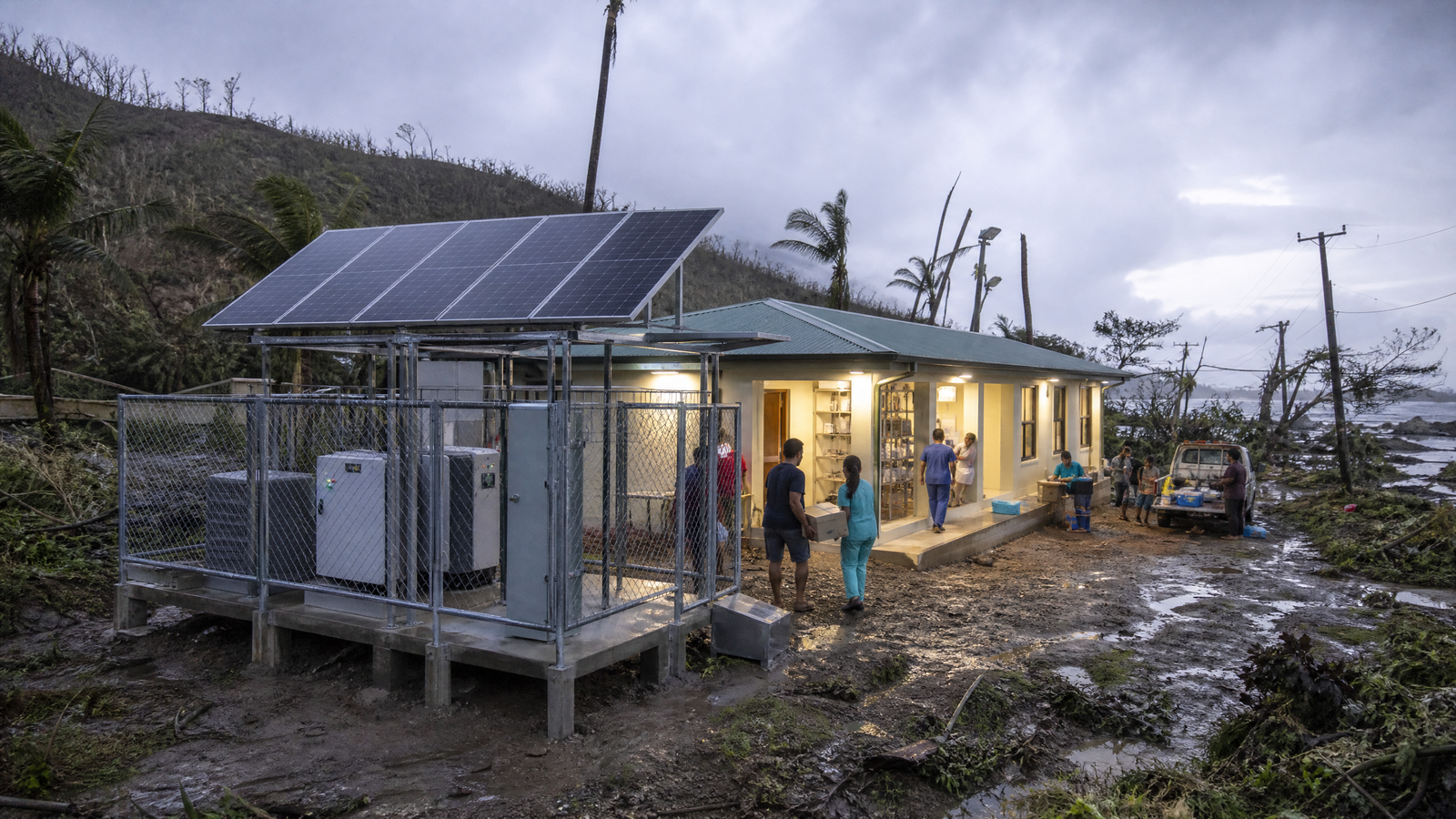
When a storm, wildfire, flood or technical failure brings down a regional power network, the consequences quickly move beyond lighting. Water pumps stop, medicines and food lose refrigeration, communications equipment cannot recharge and clinics have to reduce services. A community does not become resilient simply because it owns a generator. Smaller projects can begin with portable solar microgrids, then grow into a coordinated microgrid as critical services and local operating capacity are mapped. It becomes more resilient when essential services can continue through a disruption using an electrical system that is local, controllable and designed around the way the community actually uses energy.
That is the practical case for community microgrids: local energy systems designed to keep essential services running when the main grid is damaged or unavailable. A microgrid groups local generation, storage, loads, controls and protection into a defined electrical area. It can normally exchange power with the utility network, but it can also disconnect safely and continue operating in island mode when the wider grid is unavailable. The aim is not to make every building independent or to promise unlimited electricity. The aim is to keep the services whose interruption would cause the greatest harm running for as long as possible.
Resilience starts with services, not equipment
The first implementation decision is to identify what the community must be able to do during an outage. A health centre may need vaccine and blood refrigeration, oxygen equipment, lighting, communications, water and selected clinical circuits. A water system may need intake, treatment, chlorination, telemetry and enough pumping to maintain a storage tank. A shelter may need lighting, ventilation, charging, refrigeration and medical support. These loads have different power ratings, operating hours and tolerance for interruption.
Engineers can then divide the electrical system into critical, priority and deferrable circuits. Critical circuits remain energised unless there is a safety problem. Priority circuits can be reduced or scheduled when energy is scarce. Deferrable loads—such as some workshop equipment, water heating or non-essential cooling—can be shifted to periods when renewable generation is available. This hierarchy prevents a limited battery from being drained by low-consequence demand while a clinic or pump is waiting for power.
A good microgrid plan also begins with measured load data rather than nameplate assumptions. A pump may have a high starting current but run for only part of the day. A refrigerator may draw modest power continuously. A communications site may have a small average load but a very high consequence of interruption. Recording these patterns over time allows the system to be sized for services and operating scenarios instead of being oversized around a single peak number.
How community microgrids operate in island mode
Resilience depends on more than connecting solar panels to a battery. When the utility supply fails, the microgrid must detect the abnormal condition, isolate from the faulted network and establish its own voltage and frequency. That normally requires compatible switchgear, protection settings, communications and inverters capable of forming or supporting the local electrical reference. The system also needs a tested reconnection sequence so that it does not energise a damaged utility line or reconnect out of phase.
Black start is another practical requirement. If the battery is empty or the controller has lost its normal reference, the microgrid needs a defined way to restart the control system, establish a stable bus and bring loads back in a safe order. Critical equipment should not all start simultaneously if that would create a surge beyond the inverter or generator rating. A staged startup can energise communications first, then controls and refrigeration, followed by pumps and other loads as capacity becomes available.
Community resilience also favours designs that can fail in sections. A single large point of failure may be efficient in normal operation but difficult to repair after flooding or physical damage. Several smaller solar-and-storage systems, or a network of buildings that can operate separately and share energy when the connection is healthy, can make restoration more manageable. The right arrangement depends on local hazards, maintenance capacity, land, regulation and the cost of protecting each site.
Using renewable power directly in a community microgrid
Renewable generation is most effective when its output is matched to useful demand instead of being automatically routed through a battery. Solar electricity produced during the day can run water pumps, cold rooms, treatment equipment, workshop tools, ventilation and communications loads directly. The battery can then be reserved for evening demand, short cloud events, black-start capability and the most critical circuits. This reduces unnecessary charge-and-discharge cycles and avoids conversion losses that occur when electricity is converted into chemical storage and then back again.
Direct use does not mean that every load must operate at midday. Water tanks can provide a simple form of energy storage: pumping can increase during strong solar production while the stored water supports demand later. Cold rooms can use thermal mass and carefully managed temperature bands to reduce compressor operation when renewable output is low. Electric cooking, water heating and productive equipment can be scheduled around the solar profile where health, safety and service requirements allow it. These measures turn renewable generation into a service rather than treating it only as a source for charging batteries.
In some installations, a DC-coupled solar-and-battery architecture can reduce the number of conversion steps, particularly when the battery and photovoltaic array share a suitable inverter. Direct-DC loads may also be appropriate for some telecommunications, lighting or control equipment. These choices must be made against safety, standardisation and maintainability requirements. A theoretically efficient architecture is not resilient if local technicians cannot diagnose it or if replacement parts are unavailable.
NREL’s work on productive use in renewable microgrids highlights why utilisation matters. A system with high renewable capacity but very little daytime demand may curtail energy or require a larger battery to deliver the same services after sunset. Adding carefully selected productive loads can improve the use of locally generated electricity while supporting livelihoods, water services, refrigeration or communications. The loads still need safeguards so that essential services retain priority during an emergency [1].
Storage should be matched to the disruption
Battery capacity is only one part of resilience. A system might need a fast response to keep sensitive equipment online, several hours of evening supply, or enough energy to cover multiple cloudy days. Those are different services and should be modelled separately. Lithium-ion batteries are responsive and widely deployed, but their usable energy depends on temperature, reserve margins, degradation and the operating limits imposed by the battery-management system. Other long-duration technologies may suit particular sites, but they bring different efficiency, safety, space and maintenance requirements.
Storage is also valuable in a hybrid system. Solar can reduce fuel use during daylight, the battery can cover short interruptions and smooth changes in load, and a generator can supply sustained power during prolonged low-renewable periods. The controller can start the generator at an efficient loading point rather than running it continuously at a very light load. This is not a choice between “batteries” and “generators”; it is the design of a complete supply chain that includes fuel access, spare parts, renewable forecasts, maintenance and the consequences of failure.
Implementation in a real community
A practical project can be delivered in stages. First, map hazards and critical services. Next, measure loads and agree the minimum service level for a short outage, a multi-day isolation and a damaged-fuel-route scenario. Then select sites where solar, storage, controls and protected distribution can be installed without creating new flood, fire or security risks. The design should specify islanding, black start, load shedding, communications loss, manual fallback and safe reconnection before procurement begins. This is the same systems-level logic that underpins off-grid resilience in humanitarian operations.
The U.S. Department of Energy’s microgrid demonstration programme illustrates the direction of travel for remote, rural and islanded communities. Its supported projects include modular systems, black-start control, standardised controllers and workforce development, reflecting the fact that resilience depends on interoperability and local capability as well as generation capacity [2]. The International Energy Agency’s recent analysis of energy-system resilience similarly emphasises decentralised resources, standardised equipment, emergency procedures, secure communications and the ability to isolate damaged sections while maintaining essential services [3].
Training should be treated as infrastructure. Local operators need to understand alarms, battery state of charge, generator start conditions, load priorities, safe isolation and the limits of remote control. Communities also need a maintenance plan for filters, batteries, inverter cooling, switchgear, solar modules, fuel systems and communications. A microgrid that requires a specialist to fly in for every reset is not independent in practice.
Protecting the system from local hazards
Renewable generation and storage still have to survive the hazard they are intended to mitigate. Flood-prone batteries and switchboards may need elevation and protected access. Solar structures require wind and corrosion design. Inverters and control cabinets need thermal management, dust protection and safe inspection routes. Generators require ventilation, exhaust control and fuel storage that remains usable after the event. Cybersecurity also matters because a distributed system creates more controllers, gateways and communications paths that must be segmented and monitored.
Testing should include loss of utility supply, a failed generator start, low battery state of charge, unexpected load pickup, loss of communications, a damaged sensor and a safe manual shutdown. After the test, operators should be able to explain which services remain powered, which loads are shed and what action is required. Resilience is demonstrated by the response to a fault, not by a diagram showing that all the components are connected.
Microgrids as community resilience infrastructure
Community microgrids reduce reliance on a large electrical grid by giving essential services another operating mode. They do not eliminate the value of the regional network: the grid remains a source of energy, balancing and recovery support. The resilience benefit comes from having local generation, storage and controls that can continue to serve a defined set of loads when the wider system is damaged or inaccessible.
The most efficient design is rarely the one with the biggest battery or the largest generator. It is the one that uses renewable electricity directly when it is available, stores only what must be shifted across time, sheds low-priority demand transparently and gives local operators the tools to keep the system safe. That combination can make clinics, water systems, shelters, communications and small businesses more capable of continuing through disruption while reducing fuel dependence in normal operation. It also connects community microgrids to the wider case for distributed energy resilience.
References
- National Renewable Energy Laboratory, Productive Use of Energy in African Micro-Grids: Technical and Economic Considerations.
- U.S. Department of Energy, Energy Department Announces Microgrid Solution Projects in Underserved and Indigenous Communities.
- International Energy Agency, Energy System Resilience: Lessons Learned from Ukraine.
- Sandia National Laboratories, Microgrids and Energy Storage Webinar Series.
- National Renewable Energy Laboratory, Check the Stack: An Enabling Framework for Resilient Microgrids.
- U.S. Department of Energy, Power in the Storm: Capturing the Value of Microgrid Resilience.
