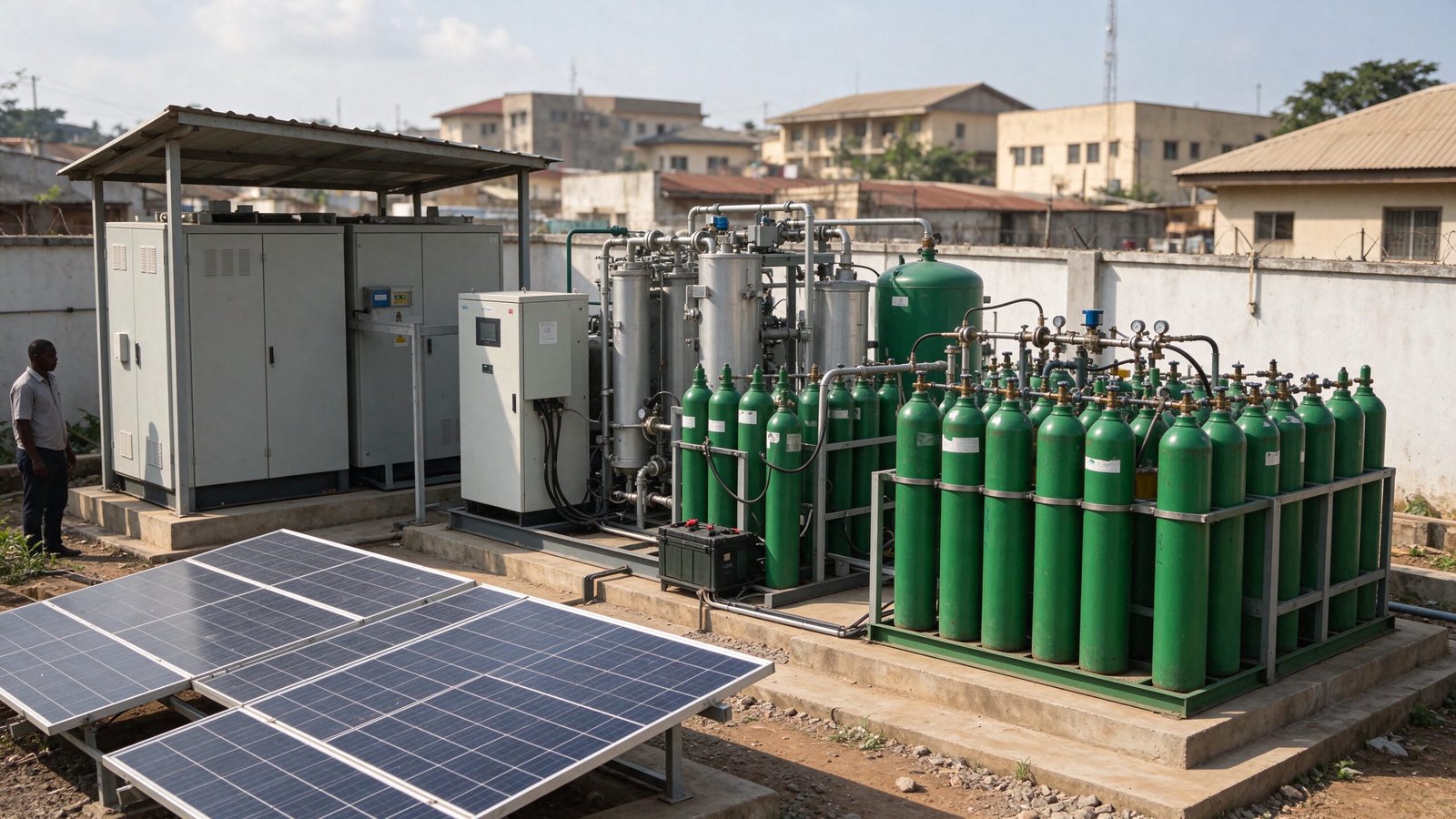
On 29 May 2024, UNICEF handed over a fully solar-powered pressure swing adsorption (PSA) oxygen plant to Jericho Specialist Hospital in Ibadan, Oyo State. The handover was not simply a ceremony around a solar array. It marked the transfer of a small medical-gas utility: a system intended to draw ordinary air, separate its gases, store and distribute medical oxygen, and keep that service available when grid power and cylinder supply chains are unreliable. 1
The project sits at the intersection of three infrastructure problems. Oxygen has to meet a medical specification. The plant has to run compressors, controls, dryers, valves and filling equipment. The hospital has to turn the gas into safe bedside treatment through a distribution network, trained staff and clinical protocols. Solar generation addresses only part of that chain, even when it is the part most visible in photographs.
UNICEF’s release describes the installation as Nigeria’s first fully solar-powered PSA oxygen gas plant and says it was created by EM-ONE through a UNICEF innovation challenge, with funding from the Government of Norway and other partners. Those are provider- and programme-reported claims. They describe the project’s stated provenance; they are not an independent certification of global precedence, plant availability or patient outcomes. 1
The medical problem is not just a shortage of cylinders
Medical oxygen is an essential medicine rather than a general-purpose industrial gas. WHO’s PSA specification says that only high-quality, medical-grade oxygen should be administered to patients and sets minimum requirements for PSA plants used for that purpose. 2 WHO’s later health-facility guidance treats the complete oxygen system as a chain comprising the source, storage and distribution products inside the facility. 3
That distinction matters in a hospital. A cylinder can be full and still be unusable if its valve, regulator, connector or pressure is wrong. A generator can be producing gas and still fail clinically if purity is not monitored, storage is inadequate, the pipeline loses pressure, or nurses cannot obtain the right flow at the bedside. The useful unit of analysis is therefore not the panel or the PSA skid alone. It is the hospital’s oxygen pathway from ambient air to patient interface.
The need is acute for the conditions UNICEF names in its handover announcement: respiratory illness, postoperative care, intensive care and newborn care. The same release says the new plant is intended to support a Level-2 newborn unit at Jericho, which UNICEF furnished alongside the oxygen installation with funding from the Gates Foundation. 1 A newborn unit creates a demanding load profile. Oxygen may be required continuously for some patients, intermittently for others, and at different flows across respiratory support devices, incubators and resuscitation equipment.
How pressure swing adsorption makes oxygen
Air is mostly nitrogen and oxygen, with small amounts of argon, carbon dioxide, water vapour and other gases. A PSA oxygen plant does not manufacture oxygen by a chemical reaction. It concentrates the oxygen already present in air by exploiting the different way gases interact with a porous adsorbent, normally a zeolite molecular sieve.
A compressor first supplies filtered, pressurised air. In an adsorption vessel, the zeolite preferentially holds nitrogen molecules when the bed is at elevated pressure. Oxygen passes through in a more concentrated stream, along with some argon and residual gases. The product gas is then buffered, analysed and sent either to the hospital system or to a filling manifold.
The bed cannot adsorb nitrogen forever. Once it approaches its working loading, valves reduce its pressure and a portion of oxygen-rich gas may be used to purge the bed. Nitrogen is released to atmosphere, the zeolite is regenerated, and the vessel is repressurised. A second bed operates out of phase. One bed adsorbs while the other regenerates, so the plant can provide a substantially continuous product stream rather than waiting for one vessel to complete a full cycle.
That cycle explains the name “pressure swing.” The separation depends on changing pressure, not on a one-time filter that becomes permanently blocked. It also explains why the plant is an electromechanical system. Compressors, air treatment, valves, instrumentation, control logic and alarms all have to work together. Moisture and oil carryover are not minor housekeeping issues: they can damage the adsorbent or contaminate the product path, which is why inlet filtration, drying and scheduled servicing are part of a medical PSA installation.
The output must be verified rather than assumed. WHO’s specification frames a PSA plant as a source of medical-grade oxygen, but a project announcement alone does not provide the full commissioning record, purity logs, calibration certificates, pressure data or alarm history for Jericho. 2 The safe interpretation is that the plant was designed and handed over for medical use, not that the public documentation proves a particular purity or uptime on every day since commissioning.
What “fully solar-powered” means in this project
EM-ONE describes two solar-plus-storage microgrids built for the UNICEF oxygen plants at Jericho Specialist Hospital and Muhammadu Buhari Specialist Hospital in Kano. Its published project description gives the paired systems a combined capacity of 80.3 kilowatt-peak of photovoltaic generation and 139 kilowatt-hours of energy storage. 4 The public page does not break those figures into a separate Jericho-only rating, so they should not be presented as the Ibadan plant’s individual PV or battery size.
The architecture is best understood as a power system wrapped around a medical process. Photovoltaic modules produce direct-current electricity during daylight. Power electronics convert and regulate that energy for the plant’s alternating-current loads and battery charging. The battery stores energy for periods when the array is producing less than the plant requires. An energy-management controller decides how solar generation, battery discharge and any available external source are coordinated.
The load is not just the oxygen product gas. It includes the air compressor, refrigeration or drying equipment, controls, sensors, solenoid valves, ventilation, pressure management and the high-pressure compressor used when cylinders are filled. Starting currents and compressor cycling can be more demanding than the average energy number suggests. A system sized around daily energy alone can still trip if inverter power, battery discharge capability or motor starting capacity is inadequate.
EM-ONE says the storage was included so the oxygen plants could continue operating through cloudy or rainy periods. 4 That is a design intention, not a public guarantee of unlimited autonomy. Battery autonomy depends on the actual plant load, state of charge, weather, battery age, reserve settings and whether other hospital loads share the microgrid. “Solar-powered” also does not mean that sunlight directly drives oxygen into a patient’s mask. It means the electrical supply for the production system is designed around solar generation and storage.
The distinction between dedicated and shared loads is important. The public descriptions identify a solar microgrid for each hospital oxygen plant, but they do not publish a complete single-line diagram for Jericho, the emergency-power changeover sequence, the exact point of grid interconnection, or the allocation of battery reserve between the oxygen plant and hospital services. Those details determine how the system behaves during a cloudy day, a battery fault, a controller fault or a maintenance shutdown.
From product gas to cylinders
A PSA plant can send oxygen directly into a hospital pipeline, but cylinder filling adds a separate high-pressure stage. Product gas first enters a buffer or receiver at the plant’s operating pressure. A booster compressor then raises the oxygen pressure to the level required for the cylinders. A filling manifold distributes gas to several cylinders, with isolation valves and pressure monitoring for controlled filling.
The cylinder operation is not simply “connect bottles and wait.” Staff must check cylinder identity, inspection status, valve condition and residual contents. The filling area needs ventilation, separation from ignition sources and procedures for handling high-pressure oxygen. Oil and grease contamination are especially dangerous in oxygen service. After filling, cylinders need a legible status, a pressure check and a controlled route to storage or the ward.
UNICEF’s note to editors says the Jericho plant can fill 135 “20-liter bottles” in a 24-hour period and provide 720,000 litres of medical oxygen over the same period. It also says that this capacity would allow 100 children with severe pneumonia or 50–60 COVID-19 patients to receive round-the-clock oxygen simultaneously. These are UNICEF-reported design or capacity claims, not an independent performance test published with the handover release. 1
The units need careful reading. A cylinder’s water capacity is not the same as the volume of free oxygen available at atmospheric pressure. The usable gas depends on fill pressure, residual pressure, regulator settings, leakage, temperature and the clinical flow delivered. Likewise, “720,000 litres in 24 hours” is a standardised gas-volume figure unless a source specifies otherwise; it should not be read as 720,000 litres of liquid oxygen or as a promise that every litre can be delivered at every bedside pressure simultaneously.
The two UNICEF figures are also not automatically additive in the way a headline might imply. A plant may fill cylinders while supplying a pipeline, but the product flow available to each path depends on compressor capacity, buffer storage, demand and the operating schedule. The release does not publish a load curve showing how the 24-hour output was divided between cylinder filling, pipeline supply, purge losses and standby capacity. Nor does it state whether the 135-cylinder figure is a nameplate maximum, a validated routine rate or a planning assumption.
Hospital integration is where reliability becomes clinical
At Jericho, oxygen has to cross a boundary between an engineering compound and clinical work. A pipeline distribution system normally includes a source connection, isolation valves, pressure regulation, zone or ward branches, terminal outlets and alarms. Each ward then uses a flowmeter or respiratory device appropriate to the prescription. The system must maintain adequate pressure at the farthest active outlet while avoiding unsafe overpressure at nearer points.
A Level-2 newborn unit makes that integration especially consequential. A nurse may need oxygen for a resuscitation event, a newborn receiving continuous positive airway pressure, or a child who needs supplemental flow while being monitored. In the operating theatre, anaesthesia and recovery create another demand pattern. Intensive care can impose sustained consumption. Emergency treatment can create short, high-flow peaks. A plant that performs well at a steady test load still needs buffers and operating procedures for these changes.
Clinical oxygen is prescribed according to the patient’s condition and monitored with the appropriate clinical observations. The plant does not decide the flow or concentration a patient should receive. Its role is to provide a safe source at the pressure and quality required by the hospital’s medical-gas system. This separation protects against a common category error: equating production capacity with improved outcomes. Oxygen availability is necessary for oxygen therapy, but outcomes also depend on diagnosis, monitoring, trained staff, compatible equipment, infection prevention and timely escalation.
The hospital needs a fallback mode. If the PSA plant is down, cylinders can support selected wards while repairs proceed. If the pipeline is isolated, cylinders may be connected through approved regulators at the point of care. If power electronics or batteries fail, an alternative electrical source may be needed. The public project pages do not disclose Jericho’s cylinder inventory, automatic changeover arrangement, minimum reserve policy, alarm escalation tree or the number of independent oxygen sources. Those omissions do not mean the safeguards are absent; they mean they are not proved by the cited public record.
Maintenance is part of the oxygen supply
PSA equipment contains consumables and wear points. Air filters load with dust. Compressor oil and separators require attention where oil-lubricated equipment is used. Dryer performance affects the moisture entering the molecular sieve. Valves cycle repeatedly. Sensors drift. Battery systems age. Fans and inverters operate in heat and dust. The zeolite beds may last for years under suitable conditions, but their life depends on air quality, moisture control, operating hours and correct regeneration.
EM-ONE says its “Oxygen Plant-in-a-box” package includes the PSA plant, installation equipment, accessories, pre-planned maintenance services and staff training. 4 That is significant because a handover that ends at physical installation leaves the hospital to discover the maintenance regime after the first fault. A maintainable system needs a service schedule, spare-parts pathway, competent operators, documented alarm responses and a way to record purity, pressure, flow, energy and downtime.
Training has at least two layers. Operators need to understand start-up, shutdown, alarm acknowledgement, cylinder filling, safe isolation and routine checks. Clinical and facilities teams need to know what a low-pressure alarm means, when to switch a ward to cylinders, how to report abnormal purity or flow, and who has authority to take a source out of service. Maintenance staff need access to electrical drawings, valve and sensor documentation, battery procedures and safe oxygen-service practices.
The solar subsystem adds its own maintenance calendar. Panels need inspection and cleaning. Battery state of health and thermal conditions should be monitored. Inverters and protection devices need testing. Cable routes and earthing must be checked. A medical-gas outage caused by a failed inverter is clinically equivalent to one caused by a compressor fault, even though the repair teams and spare parts are different. Resilience comes from treating the two subsystems as one operational service with separate failure modes.
Redundancy is more than one battery
A resilient oxygen installation has layers of reserve. The first is process redundancy: two adsorption beds operating out of phase and a product buffer that smooths the cycle. The second is electrical redundancy: solar generation, battery storage and whatever standby or external source the facility can use. The third is gas redundancy: a pipeline supplied by the plant, filled cylinders and an orderly way to switch between them. The fourth is operational redundancy: more than one trained person who can run the plant, fill cylinders and escalate faults.
The public material establishes the existence of the solar-plus-storage concept and the intended hospital application, but it does not publish a formal reliability block diagram for Jericho. It does not establish whether every critical component is duplicated, how long the battery can support the full plant, or whether an independent generator remains available. Those are precisely the facts a hospital would need before describing the installation as fail-safe.
This is why the strongest interpretation of the project is not “solar eliminates outages.” It is that on-site oxygen production and a more reliable electrical architecture can reduce two recurring vulnerabilities at once: dependence on delivered cylinders and dependence on an unstable grid. They do not eliminate compressor faults, pipeline leaks, maintenance shutdowns, battery degradation, poor clinical demand management or supply-chain delays for specialised parts.
What the documented figures prove—and what they do not
The May 2024 record proves that UNICEF publicly announced a handover at Jericho Specialist Hospital on 29 May 2024. It identifies the plant as PSA, describes it as fully solar-powered, names EM-ONE as the creator, and links it to a Level-2 newborn unit and partner funding. 1 EM-ONE’s project description adds the combined PV and storage figures for the two pilot hospitals and describes the installation, training and maintenance package. 4
The record supports a credible account of the intended architecture: ambient air enters a PSA system; solar and batteries supply the electrical loads; product oxygen can be stored, distributed and compressed into cylinders; and the hospital can use the source for newborn, respiratory, surgical and critical-care workflows. WHO’s publications provide the standards context for medical-grade oxygen and for treating source, storage and distribution as one facility system. 2
The record does not establish annual oxygen delivered, measured purity over time, plant availability, battery autonomy at Jericho alone, cost per litre, emissions avoided, number of patients actually treated, mortality reduction, or the plant’s performance during a documented grid outage. It also does not independently validate the “first” designation or the simultaneous-treatment estimates. Those questions require commissioning documents, operating logs, clinical records, energy data and an evaluation designed to compare the plant with a defined baseline.
That evidence boundary is not a criticism of the project. It is the difference between reporting what was handed over and claiming what the system achieved over years of operation. For a medical utility, that distinction protects both engineering credibility and public trust.
A small plant with a large systems lesson
The Jericho installation shows why medical oxygen projects cannot be reduced to a choice between diesel and solar. The core technology is a gas-separation process. The useful output is a controlled medical service. The enabling infrastructure includes power conversion, storage, cylinder logistics, pipelines, alarms, maintenance and clinical practice.
The project’s most important design idea is therefore integration. A hospital can gain more autonomy when oxygen is generated close to demand, and it can gain more continuity when the generator’s electrical supply is designed around solar production and storage. But the result remains a system that must be commissioned, monitored, maintained and backed up like any other critical hospital utility.
At Jericho, the public documentation describes a promising model: a PSA plant connected to a solar-and-battery architecture and paired with newborn-care investment. The durable lesson is more practical than the headline. Reliable oxygen comes from making every link—from air intake to bedside outlet—visible, measurable and maintainable.
References
Additional technical context comes from WHO’s medical-oxygen guidance, UNICEF’s follow-up account of the Nigerian solarization programme, the Global Fund’s PSA sustainability guidance and comparable UNICEF and WHO field documentation. These sources reinforce the article’s central point: the plant is a complete oxygen utility whose reliability depends on quality control, power, maintenance, staffing, backup and supply planning. [6] [7] [8] [9] [10]
- WHO, Oxygen: medical-use oxygen, oxygen systems and maintenance.
- UNICEF Nigeria, 100% solar-powered oxygen supply for newborns.
- The Global Fund, Overview: Sustainability Guidance for PSA Oxygen Plants.
- WHO Somalia, Solar-powered medical oxygen systems in a fragile setting.
- UNICEF Canada, Oxygen Plant in a Box: Innovating COVID-19 Response.
