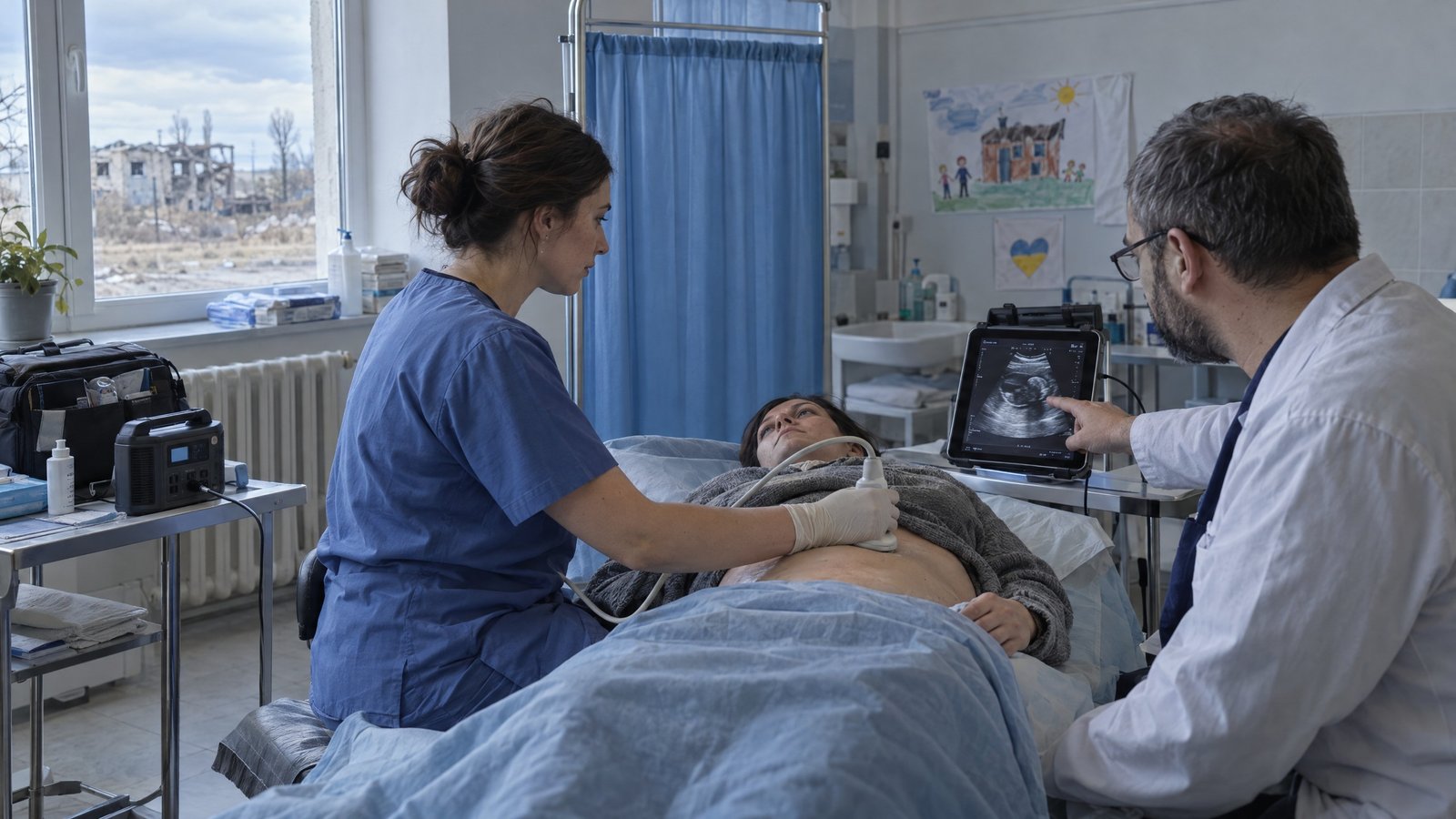
A clinician in a rural Ukrainian community may begin an examination with a question that is both clinical and logistical: can this patient be safely managed here, or does the next useful answer require a journey to a hospital? Portable ultrasound in humanitarian response can move the first useful diagnostic image closer to patients in frontline Ukraine. In a functioning referral system, that decision is supported by imaging, transport and specialist availability. In a region where villages can be as far as 65 kilometres from the nearest hospital, the distance is not an abstract figure. It affects ambulance time, fuel, staff availability, patient risk and the number of people who can be assessed in a day. [1]
Portable point-of-care ultrasound, or POCUS, changes the location of the first useful image. A handheld probe connected to a smartphone or tablet can give a trained clinician real-time views during an examination rather than requiring every patient to wait for a stationary ultrasound room. That does not turn a local clinic into a radiology department, and it does not eliminate the need for referral. Its value is more precise: it can help a clinician decide sooner which patients need escalation, which questions can be answered at the bedside, and which cases require specialist review.
The Ukrainian experience is therefore best understood as a distributed diagnostic and referral system. The probe is only one component. The working system also includes software, trained operators, image-sharing practices, regional specialists, power and connectivity plans, maintenance, referral thresholds and rules for protecting patient information. Without those surrounding capabilities, a compact device is merely a compact device.
The referral bottleneck
Diagnostic delay is consequential because clinical decisions are often time-sensitive even when the final diagnosis is not yet certain. A patient with suspected internal bleeding, pregnancy-related complications, fluid in the lungs or an obstructed urinary tract may need a different route through the health system from a patient who can be observed locally. A first bedside scan cannot answer every question, but it can add evidence at the moment when a referral decision is being made.
The Chernihiv deployment illustrates this difference between access to equipment and access to a decision. According to the Direct Relief report published through ReliefWeb, local clinicians had previously faced ultrasound delays ranging from two weeks to three months. With the project in place, the reported wait was usually two to three days. Those figures are field-report accounts, not a controlled evaluation of diagnostic outcomes, but they describe the operational problem clearly: a stationary service can be technically available while remaining practically inaccessible to a dispersed population. [1]
POCUS moves an initial imaging step toward the patient. It can be performed in a local medical station, an ambulance or another care setting, then used to support a decision about urgency and destination. This may reduce unnecessary transfers and accelerate necessary ones, but the Chernihiv field report does not establish that outcome as a measured result. In every case, the scan must remain part of a clinical assessment rather than becoming an automated verdict.
What the Chernihiv deployment actually did
AICM began its Butterfly ultrasound project in Chernihiv in 2022, in conjunction with its French partner, bringing handheld Butterfly ultrasound devices into local medical services. The Butterfly probe connects to a smartphone or tablet and provides real-time imaging through its accompanying software. Selected images can be shared with specialists in the regional capital, allowing a clinician nearer the patient to obtain a view while preserving a route to higher-level expertise. [1]
The reported scale is significant but should be read carefully. AICM distributed 47 units in Chernihiv. In the report published in December 2024, Direct Relief is described as supporting the expansion with a $110,000 grant for 25 additional probes and training. At the time of the report, 15 local doctors had been trained and 20 more were planned. AICM also donated three probes to the Poltava ambulance service in 2023, extending the concept beyond fixed local stations and into prehospital response. These are programme figures reported by the organisations involved; they do not by themselves establish how often each device was used, how many scans changed management or how image quality compared with a hospital examination. [1]
The practical achievement was the connection between a local examination and a wider clinical network. AICM first donated four stationary ultrasound machines, but the report says this was not enough to serve the dispersed population; the handheld-probe model then moved imaging closer to local medical stations. [1] A probe in a village does not solve a case if nobody can operate it, interpret the image, decide when the image is inadequate or arrange the next step. Chernihiv’s model matters because equipment distribution was paired with training and a specialist-sharing pathway. The technology shortened the distance to an initial image while keeping the referral system visible.
Other Ukrainian programmes show how rapidly that network expanded. In a press release dated 4 October 2023, Butterfly and Razom announced 200 additional Butterfly iQ+ devices for Ukraine. The release said Razom had deployed more than 400 devices, while Butterfly reported that nearly 900 devices had entered Ukraine through more than 40 global-health partnerships since February 2022. These are company- and partner-reported figures and should not be treated as an independent national inventory. The same announcement described POCUS training and use by medics and first responders, as well as in prenatal and primary care settings in shelters. [2]
Team Rubicon separately reported that it donated 50 Butterfly iQ+ probes and app subscriptions in 2022, trained Ukrainian physicians and paramedics to use the Butterfly iQ+ probe, and trained 1,549 people across POCUS and other prehospital subjects in less than two months. Its account also describes the smartphone or tablet workflow and cloud storage for images. The 1,549 figure is therefore not a count of POCUS-trained clinicians alone. The scale demonstrates the value of mobilisation, but it also reinforces a safety point made by the field account: a connected probe is not a substitute for clinical training or specialist interpretation. [3]
The technical anatomy of the workflow
A field ultrasound workflow begins with the probe, but it does not end when the probe touches the patient. The probe transmits and receives ultrasound signals; the smartphone or tablet supplies the display, software interface and, depending on the configuration, tools for selecting a preset, annotating an image and recording a short study. The operator chooses a clinical question and a suitable view, applies the probe, adjusts the image and decides whether the result is interpretable.
The software layer matters because a useful image needs context. A still frame or clip should be associated with the patient encounter, the body region, the examination question and the operator. Local image storage can support review when connectivity is unavailable, while later synchronisation can preserve continuity when a network returns. These are workflow recommendations rather than claims that every Ukrainian deployment uses the same storage architecture. They are the kinds of controls a programme should define before deployment.
Transmission is similarly a design choice, not a magic property of the probe. Where connectivity permits, selected images may be sent to a specialist in a regional centre. Where connectivity is intermittent, the workflow should support a store-and-forward mode: capture the minimum necessary study, retain it securely, transmit when a trusted connection becomes available, and record whether a specialist has reviewed it. A live remote examination may be useful in some settings, but it should not be assumed to be available in a damaged or overloaded network.
Power is part of image quality. A device with a depleted battery cannot produce a scan, and a tablet that cannot boot is an unavailable imaging station. A resilient deployment therefore needs charging options, spare cables, power banks or other backup power appropriate to the site, and a plan for keeping devices charged during transport. The same principle applies to software updates, account recovery and replacement of damaged accessories. The PLOS One scoping review identifies battery degradation, storage failure and poor connectivity among the recurring challenges of ultrasound use in austere environments. [4]
The network effect: people, protocols and referral thresholds
Training is not a ceremonial handover. POCUS is operator-dependent: the clinician must know how to position the probe, acquire a relevant view, recognise artefact, distinguish an inadequate study from a reassuring one and communicate uncertainty. Training should therefore combine image acquisition with clinical decision-making. It should answer questions such as when a scan is indicated, when a finding changes urgency, when a second view is required and when the correct action is immediate referral despite an apparently reassuring image.
The network also benefits from shared protocols. A local clinician and a regional specialist need common expectations about what views to acquire, how to label them, how to document limitations and what constitutes a referral trigger. A simple escalation rule can be more valuable than a long catalogue of possible findings. If the local study is technically limited, discordant with the examination or outside the operator’s scope, the pathway should default to human review or referral rather than force a definitive interpretation.
This is why the training figures from Chernihiv and the wider Ukrainian programmes are important. Fifteen doctors trained, twenty more planned, and the large numbers reported by Team Rubicon represent the creation of local capability rather than the distribution of hardware alone. Team Rubicon’s figure of 1,549 people covers POCUS together with other prehospital subjects, so it should not be read as a count of POCUS-trained clinicians alone. [1] [3] Capability persists when clinicians can practise, receive feedback, access replacement equipment and understand who is responsible for the next decision.
The Chernihiv account also describes a dedicated Telegram group of about 130 doctors in which pathologies and treatment pathways were discussed, while noting that patient confidentiality remained important. [1] This illustrates the informal network layer that can make distributed devices useful: local clinicians are not isolated after training. It also creates a governance obligation. Messaging applications that were not designed as clinical records can expose images, identifiers or discussion histories through screenshots, forwarding, weak account protection or unclear retention. A programme should define when such a channel is permitted, what information may be shared, and when a secure clinical system or direct specialist referral is required.
Beyond the hospital
The same architecture can serve several care environments, but the clinical question changes with the setting. In an ambulance, POCUS may contribute to rapid assessment before arrival and help paramedics communicate the urgency of a case. In a shelter or temporary clinic, it may support prenatal or primary-care encounters where a hospital scan would otherwise require a separate journey. Butterfly and Razom explicitly described such use in their Ukraine programme, including prenatal and primary care in shelters. [2]
In oncology or paediatric care, the device may be used as part of a focused assessment or to guide a decision about referral, but the risk of overinterpreting a limited study is substantial. The Chernihiv report describes uses across specialties including oncology, cardiology, nephrology and endocrinology, as well as a paediatric case in which clinicians used a probe while trying to locate an air-gun pellet moving around a boy’s knee. These are illustrations of focused imaging, not evidence that a handheld probe replaces comprehensive specialist imaging. [1] A portable scan can show a relevant finding without characterising the entire disease process. It can support triage, monitoring or procedural planning only within the competence of the operator and the available referral pathway. The right question is not whether the device can be used in a particular population, but what narrowly defined question it can answer safely there.
The Poltava ambulance donation is a concrete example of that shift from hospital-centred equipment to distributed response. AICM donated three probes to the ambulance service in 2023. [1] The number is small, but the design implication is large: imaging can travel with the care team, provided the team has training, power, cleaning supplies, documentation and a destination capable of acting on the information.
Engineering for austere conditions
A device intended for frontline or rural use should be engineered around the environment it will actually encounter. The PLOS One review identifies temperature, humidity, rain or sand, sunlight, battery problems, storage failures, weak connectivity and limited technical support as challenges reported across austere settings. It also finds important benefits: portability, the absence of ionising radiation, live imaging, rapid feedback and the possibility of transmitting images. The review included 324 studies, among them 39 conflict-zone studies and 101 prehospital studies. Its evidence quality was variable: 74 studies were rated high quality, 129 moderate, 82 low and 56 very low. Thus, only 74 of the 324 included studies received the highest quality rating, and the authors note that high-quality implementation evidence remains limited. [4]
Those findings suggest practical recommendations rather than a universal equipment checklist. Programmes should specify how probes and tablets are cleaned between patients, how moisture and dust are controlled, how devices are protected during transport and how batteries are tested and replaced. They should identify who owns each device, who can authorise repairs, where spare accessories are held and what happens when a device is lost, damaged or reassigned.
Connectivity planning should include failure. A local team may need to capture images offline, record a concise clinical note, and transmit later through an approved channel. If the programme depends on a cloud service, it should define account ownership, access recovery, service continuity and the conditions under which images are deleted from local storage. If it uses local storage, it needs encryption, backup and a controlled method for specialist access. These are recommendations for resilient implementation, not claims about the configuration of any particular field programme.
Clinical limits and safety
POCUS is a focused examination performed at the point of care, not a replacement for a full stationary radiology service. It may answer a targeted question quickly, but it does not automatically provide the breadth, image set, reporting process or specialist oversight of comprehensive diagnostic imaging. Its results depend on the operator, the patient’s condition, the acoustic window, the selected preset and the quality of the device and display.
A normal-looking limited scan cannot exclude every serious condition. A finding may be real but nonspecific. An image may be technically inadequate without appearing obviously unusable to an inexperienced operator. For these reasons, the safe workflow is built around uncertainty: document the question, record the limitation, seek review when indicated and refer when the clinical picture and the scan do not agree. The PLOS One review’s emphasis on required training and limited implementation evidence supports this cautious posture. [4]
Specialist interpretation remains essential for cases beyond the operator’s scope. Image sharing can reduce isolation, but it does not remove the need for a clinician who can integrate the scan with history, physical examination, laboratory results and the patient’s trajectory. Portable ultrasound extends diagnostic capacity; it does not abolish clinical responsibility.
Data protection and operational governance
Image-sharing introduces a second system to govern: patient data. A programme should obtain consent appropriate to the setting, share only the images and identifiers necessary for the clinical purpose, and define who may access them. Access controls should be role-based, accounts should not be shared, and review activity should be auditable where the software permits. Retention should have a defined purpose and period rather than becoming indefinite by default.
The minimum necessary principle is particularly important when images move between a local station and a regional specialist. A programme should distinguish the clinical record from operational metadata, protect devices with authentication, and establish what happens when a phone or tablet is lost. It should also clarify whether images are stored locally, in a managed cloud service or in both places, and how they are removed when retention ends. These governance measures are not optional technical polish: they determine whether a referral pathway can remain trustworthy under pressure.
What this case teaches
The Ukrainian deployments show that successful technology transfer is a systems exercise. AICM’s Chernihiv work combined distributed probes with clinician training and a route for selected images to reach specialists in the regional capital. Direct Relief supported expansion with funding for additional devices and training. [1] Butterfly and Razom described a broader network of devices and POCUS education, while Team Rubicon documented an intensive training and equipment effort for physicians and paramedics. [2][3]
The durable lesson is not that every clinic needs a handheld ultrasound. It is that a portable diagnostic tool becomes valuable when its surrounding pathway is designed in advance. Local clinicians need defined questions they can answer, training that matches their scope, a method for obtaining specialist help, equipment that can be powered and maintained, and governance that protects patients. Regional hospitals need referral information they can use. Programme managers need evidence about utilisation, image quality, turnaround time and patient outcomes rather than relying only on the number of probes delivered. The scoping review reaches a similar caution from the wider literature: because study quality and settings vary, additional high-quality research is needed to guide training and establish how POCUS changes clinical outcomes in different austere environments. [4]
A probe can shorten the distance to an image. Only a functioning clinical network can shorten the distance to a safe decision.
References
- How portable ultrasound devices strengthened medical expertise in frontline Ukrainian region
- Butterfly and Razom Expand Global Health Partnership to Ukraine
- Ukraine Volunteers Equip Paramedics with Ultrasounds, Smartphones and Training
- Point-of-care ultrasound use in austere environments: a scoping review
