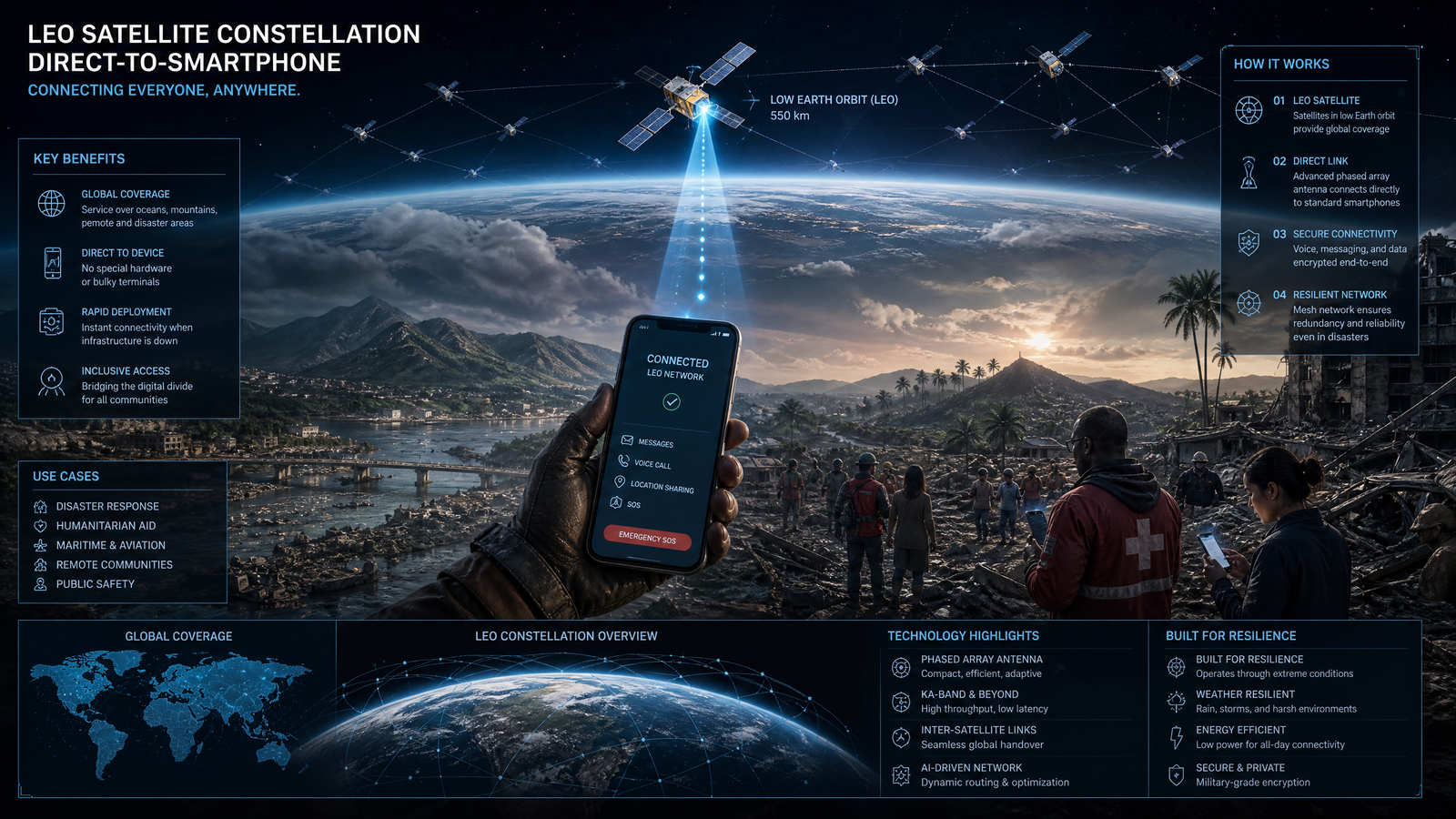
Imagine an emergency manager standing at the edge of a flooded district after terrestrial service has failed. The radio team is working, but its channels are crowded. A portable satellite terminal is online at the coordination point, yet most residents and volunteers do not have one. A person outside the damaged area needs to send a short welfare message. Another needs to receive an evacuation alert. The question is not whether satellites exist overhead. It is whether an ordinary phone, on an approved mobile plan and under the right conditions, can exchange a useful message with one.
That scenario captures the promise of satellite-to-cell, also called direct-to-device (D2D) connectivity. It can narrow the communications dead zone without requiring every user to carry a specialist terminal. But it is not a magic replacement for a restored cellular network, a satellite broadband kit, a deployable LTE cell, or a disciplined field communications plan. The distinction matters most in a disaster, when a reassuring claim about “coverage” can quickly become an operational assumption.
Satellite-to-cell is best understood as a supplementary coverage layer. Its near-term disaster value is strongest in short messages and alerts, while voice, interactive data, and broadband require more demanding link budgets, network integration, and capacity. The technology may give a compatible handset a path out of an isolated area, but that path still depends on radio physics, satellite geometry, operator agreements, regulation, power, authentication, and the ability of people to use it correctly.
One phrase, several different systems
A conventional satellite terminal is a purpose-built radio. It uses a directional or electronically steered antenna, a power system, and a modem designed to close a link to a satellite. A field team may connect laptops, phones, a local Wi-Fi network, or a voice system through that terminal. Its advantages are controllable equipment and, where capacity is available, a much wider range of applications. Its disadvantages are the need to transport, power, point, register, protect, and operate specialist hardware.
Satellite backhaul is different again. A local cellular or Wi-Fi system may use a satellite link to reach the wider network. Users connect to a nearby access point or deployable base station, not directly to the satellite. This can restore a local communications bubble, but it requires equipment on the ground and a functioning local radio layer.
Deployable LTE or other rapidly installed cellular systems put the access network near the people who need it. They can support ordinary handsets, but the system still needs a site, backhaul, spectrum coordination, power, configuration, and usually trained personnel. A mesh network, meanwhile, lets nearby devices or local nodes relay traffic among themselves. Meshes can be useful when infrastructure is damaged, but they are constrained by node density, battery life, routing, and the point where traffic must eventually exit the affected area.
Direct-to-device attempts to move part of the access network into orbit. A satellite acts as a radio access element that communicates with an unmodified or minimally modified handset, usually through a terrestrial mobile operator’s spectrum and core-network arrangements. The phone remains a phone: it must support the relevant service, be associated with an operator or approved roaming relationship, and have enough battery and sky visibility to make the exchange. “No specialist terminal” therefore does not mean “no setup.” It means that the user may not need to carry a separate satellite modem.
The practical distinction is also between service types. Messaging is a small, delay-tolerant transaction. Voice needs a more continuous and predictable link. Broadband requires sustained throughput in both directions and enough capacity for many users at once. A provider may be able to support one of these layers while another remains limited, experimental, geographically restricted, or unavailable.
Why an ordinary phone is a difficult satellite terminal
The engineering challenge begins with the handset. A mobile phone is designed to communicate with a nearby terrestrial site, not a satellite hundreds of kilometres above it. Its transmit power is limited by battery, thermal design, safety requirements, and the need to share a compact antenna with several bands and radios. Its antenna has low gain compared with a satellite terminal and is often held at an unpredictable orientation, close to a person’s body or inside a vehicle.
Free-space path loss increases with distance and frequency. A satellite-to-phone link therefore starts with a severe signal penalty before accounting for foliage, walls, rain, body loss, polarization mismatch, and interference. The satellite must receive a weak uplink from a moving, low-gain transmitter and return a usable downlink without overwhelming terrestrial networks operating in the same or neighbouring bands. The link budget is a negotiation among transmit power, antenna gain, coding, bandwidth, receiver sensitivity, elevation angle, and the time available to complete the exchange.
Low Earth orbit helps by reducing path length compared with higher orbits, but it introduces motion. The relative velocity between satellite and handset produces Doppler shift, potentially large enough to challenge a radio designed for a stationary terrestrial cell. Timing also changes as the satellite moves and as users occupy different positions within a beam. Starlink describes its Direct to Cell system as addressing Doppler, latency, low handset antenna gain, and low handset transmit power through phased-array antennas, custom silicon, and software algorithms. [2]
A phased array lets the spacecraft form and steer beams electronically. It can shape coverage, track the apparent motion of a handset, reuse frequencies in separated areas, and adapt to changing demand. Beamforming is not a way around physics: it concentrates available energy and improves spatial control, but the system still has finite power, spectrum, antenna aperture, and processing capacity. Frequency reuse also creates an interference-management problem. A beam serving one area must be coordinated with adjacent beams and with terrestrial users of the operator’s spectrum.
The network side must look enough like a mobile network for the handset and the operator core to cooperate. Starlink says its rollout uses partner mobile-network-operator spectrum in the 1.6–2.7 GHz range and that integration is similar to roaming. [2] In practical terms, this means a phone must discover or select an approved network identity, register, authenticate, and obtain the service permissions associated with its subscription. The operator must know how to route the message, apply policy, record usage, and handle a device that moves between terrestrial and satellite coverage.
Handover is especially important. A user may begin near a surviving cell, lose that cell while a satellite is visible, and later return to terrestrial coverage. The system must avoid duplicate delivery, preserve security context where appropriate, and cope with changing signal conditions. A satellite pass may provide only a window of useful geometry. The service may also be deliberately throttled or limited to messages so that a large number of users can share scarce capacity.
These mechanics explain why “direct to any phone, anywhere” is an unsafe operational interpretation. Device compatibility, operator participation, geography, regulatory authorization, subscription status, sky view, satellite position, and beam loading all matter. A provider can make substantial technical progress without creating a universal, continuously available broadband cell in orbit.
What is operational now—and what that claim means
The clearest current operational example in the verified source set is Starlink’s February 2025 announcement. SpaceX stated that commercial satellite messaging was available in the United States and New Zealand for 4G LTE mobile phones through T-Mobile and One NZ, with more countries planned. It described a rollout involving more than 400 satellites and cited millions of messages during 2024 beta and emergency scenarios. These are provider-reported deployment and usage claims, not an independent assessment of service quality in every location. [2]
SpaceX also reported that special authority from the U.S. Federal Communications Commission enabled T-Mobile subscribers to send texts outside terrestrial coverage and receive Wireless Emergency Alerts during Hurricanes Helene and Milton and the Los Angeles wildfires. [2] The important operational point is the service mode: emergency messaging and alerts can be useful even when the system cannot support ordinary broadband. A short message may tolerate delay, retries, compact payloads, and constrained throughput that a video call or cloud application cannot.
Messaging should not be conflated with broadband. A message service may have enough capacity to exchange text while lacking the continuous downlink, uplink, latency, or scheduling margin needed for a high-volume data session. Capability is expanding in some partner markets, including limited data or application support, but those services remain constrained by device models, operator plans, coverage windows and network capacity. Messaging remains the most mature and predictable disaster use case in the source set. It may work outdoors but not inside a reinforced building. It may deliver an alert to a compatible, registered handset while offering no guarantee that every person in the affected population has a compatible device, an eligible operator, a charged battery, or a clear view of the sky.
The second relevant example comes from SpaceX’s Progress 2025 report on Hurricane Melissa in Jamaica. SpaceX reported that nearly 1,000 donated Starlink kits were deployed in the Caribbean, with more than 900 going to the Jamaican government and relief organisations. The report said responders used those kits for aid distribution, logistics, field assessments, emergency medical services, community Wi-Fi, backhaul, and air-to-ground communications. It separately reported that Direct to Cell activation in Jamaica enabled more than 1.1 million SMS messages in the first month from areas without cell service. [3]
Those figures should not be blended into one generic claim that “Starlink restored communications.” They describe two different layers. The kits are terminal-based connectivity: specialist hardware placed at field sites to create a broadband or local access point. Direct to Cell is a handset-to-satellite messaging layer. Both may be valuable in the same response, but they solve different problems, have different users, and require different logistics. The figures are company-reported and should be treated as such rather than as an independent evaluation of reach, delivery time, or user outcomes.
Other providers describe broader direct-to-device ambitions. AST SpaceMobile says its network is designed to provide cellular broadband directly to standard, unmodified phones with operator partners, while also noting that initial service and testing are non-continuous and operator-dependent. Its published milestones and performance claims are company-reported and should not be treated as universal operational availability. [4] For disaster planners, the safe assumption is not that a future capability will be present, but that each service must be verified for the country, operator, device, application, and response phase in which it is expected to work.
Public safety is a regulatory and governance problem
Radio access alone does not make a public-safety service. In the United States, the FCC’s Supplemental Coverage from Space framework enables satellite operators and terrestrial providers to collaborate using spectrum previously allocated to terrestrial service. The framework treats SCS as secondary, bi-directional mobile-satellite operations in specified bands and requires a terrestrial licensee’s spectrum leasing or agreement. Geographic scope and interference protection are central conditions. [1]
The framework also addresses responsibilities that become critical during an emergency. The FCC requires interim arrangements for 911 voice and text routing, location information, and transmission of phone-number information for providers using SCS, alongside privacy certifications and consumer disclosures. [1] These requirements recognize that a message reaching a satellite does not automatically reach the correct public-safety answering point, include reliable location, or preserve the same expectations as terrestrial service.
A response organisation should therefore distinguish “can send” from “can summon the right help.” Emergency calling may be subject to a different service path, device behaviour, coverage footprint, and routing policy than ordinary SMS. Location may be approximate, unavailable, delayed, or dependent on handset and network conditions. Privacy obligations also persist when communications cross commercial networks, satellites, national borders, and multiple organisational systems. The FCC describes its framework as an initial step balancing innovation, service quality, and protection against harmful interference. [1]
The operational value—and the failure modes
Used honestly, D2D can provide a valuable first thread to the outside world. Residents may send a welfare message. A responder may report that a team reached a site. An authority may distribute a concise alert. A relief organisation may coordinate a change in meeting point when terrestrial service is down. The user experience can be simpler than deploying a terminal, and coordination with a mobile operator can extend an existing identity and subscriber relationship rather than creating a completely separate access system.
The first limit is visibility. A phone generally needs a sufficiently open path to the sky. A concrete structure, steep terrain, dense canopy, or a vehicle roof can reduce or block the link. The satellite’s elevation and trajectory matter, so a service that works in one open location may fail a few metres away. Weather may not be the only or even the dominant factor; obstructions, geometry, and handset orientation can be decisive.
The second limit is capacity. A satellite beam has finite resources, and disasters concentrate demand precisely when users are most anxious to communicate. Congestion can produce delay, retries, or service prioritisation. Emergency messages and public warnings may be prioritised over ordinary traffic, while non-critical traffic may be throttled or deferred, but the exact policy is service- and operator-dependent. A message may eventually arrive without being suitable for a time-critical exchange. A large population cannot be assumed to receive continuous service merely because a satellite is overhead.
The third limit is the handset. Battery depletion, damaged devices, software state, SIM or eSIM status, unsupported bands, and service-plan restrictions can all prevent use. A compatible phone is not necessarily an enabled phone. Operator and country availability may change, and a user crossing a border may encounter different authorisation and spectrum arrangements.
The fourth limit is expectation. If an organisation tells residents that satellite-to-cell “works everywhere,” people may wait for a text that cannot be delivered, ignore a local radio instruction, or treat an unconfirmed message as authoritative. Cybersecurity and privacy risks also remain: compromised accounts, spoofed alerts, malicious links, metadata exposure, and uncertainty about who is authorised to send high-consequence instructions. An unauthenticated, delayed or contradictory message should never override an established local command channel; message origin and authority must be verified through the response structure.
Designing it into a humanitarian communications system
A resilient plan treats D2D as one bearer among several. In the first hours, teams should be able to use terrestrial networks where they survive, public-safety radio, satellite terminals, deployable LTE, and local mesh or Wi-Fi systems where appropriate. D2D can provide an additional path for short messages to compatible users, while a terminal or deployable cell supports coordination traffic, local access, and applications that messaging cannot carry.
The design should begin with a contact tree rather than a technology demo. Define who may send an alert, who receives it, what acknowledgement means, and which channel is used if no acknowledgement arrives. Prepare short, plain-language templates for welfare checks, evacuation instructions, medical escalation, team movement, and “do not reply” broadcasts. Store-and-forward logic can reduce the consequence of temporary loss: a message can be queued, timestamped, retried, and marked delivered only when the system receives a meaningful confirmation.
Power deserves the same attention as spectrum. Charge banks, vehicle power, solar options, terminal batteries, and procedures for rationing handset use are part of the communications architecture. Training should include finding an open-sky position, keeping the handset oriented and dry, recognising pending versus delivered status, and switching to a fallback bearer. Registration, consent, identity management, and privacy controls should be tested before a crisis, not improvised while networks are failing.
Operators and authorities should agree on priority access and escalation. A public warning, a medical team’s message, and a routine administrative update should not necessarily compete equally for a constrained channel. Monitoring should record attempted messages, delivery latency, retries, failed causes where available, coverage conditions, battery state, and which alternative bearer carried the traffic. An after-action review can then distinguish a radio failure from a process failure, such as an untrained user or an obsolete contact list.
Different roles across the response cycle
In the first hours, D2D is most useful as a thin lifeline. Short emergency messages and alerts may reach people outside terrestrial coverage, provided the handset, operator, satellite geometry, and regulatory conditions align. The priority is speed and clarity, not replacing every field network. Emergency managers still need a command channel with predictable capacity and a way to verify what happened at the edge of coverage.
During the sustained response, the centre of gravity shifts to coordination. Terminal-based satellite connectivity, deployable LTE, repaired terrestrial sites, and local Wi-Fi or mesh networks can support maps, logistics systems, telemedicine workflows, and larger teams. D2D messaging can complement those systems by reaching dispersed staff and residents, but its role should be bounded by capacity and delivery uncertainty. A field organisation that depends on direct-to-device for all data has probably designed the wrong architecture.
In recovery, D2D can remain useful while communities wait for permanent infrastructure. It may provide continuity for alerts, welfare checks, and coordination during phased restoration. Yet the recovery objective should be to restore accountable local networks and services, not to institutionalise a temporary orbital layer without assessing cost, privacy, inclusion, and local operator capacity. People without compatible devices, subscriptions, electricity, language access, or safe outdoor space must remain visible in the plan. That includes translated and accessible messages, alternatives for people with hearing, vision or cognitive disabilities, and pre-positioned community access points where trained staff can relay information for residents who cannot connect directly.
Conclusion: a smaller dead zone, not a complete network
Satellite-to-cell changes the shape of the disaster communications problem. It can place a narrow, potentially life-saving path between an ordinary handset and a satellite when a terrestrial site is unavailable. Current provider announcements show meaningful progress in satellite messaging and emergency use, while regulatory frameworks are beginning to define how commercial satellite and terrestrial operators can share spectrum and public-safety responsibilities. [1][2][3]
The core insight is more disciplined than the headline. Direct-to-device is a supplementary coverage layer that can reduce the communications dead zone; it is not a replacement for local networks, satellite terminals, deployable LTE, mesh systems, or field communications planning. Its value comes when planners match the bearer to the message, disclose the limits, provide power and training, and retain fallbacks. In a disaster, resilience is not the presence of one impressive link. It is the ability to keep useful information moving when every individual link is partial.
