The cable nobody thinks about
When a storm, an earthquake or a missile strike hits, the mobile network is how most people find out what happened and how they ask for help. Responders use it to coordinate. Authorities use it to send warnings. We tend to picture the cell tower when we think of that network, but a tower on its own does very little. It needs a connection back to the core, and in most networks that connection is a fibre cable.
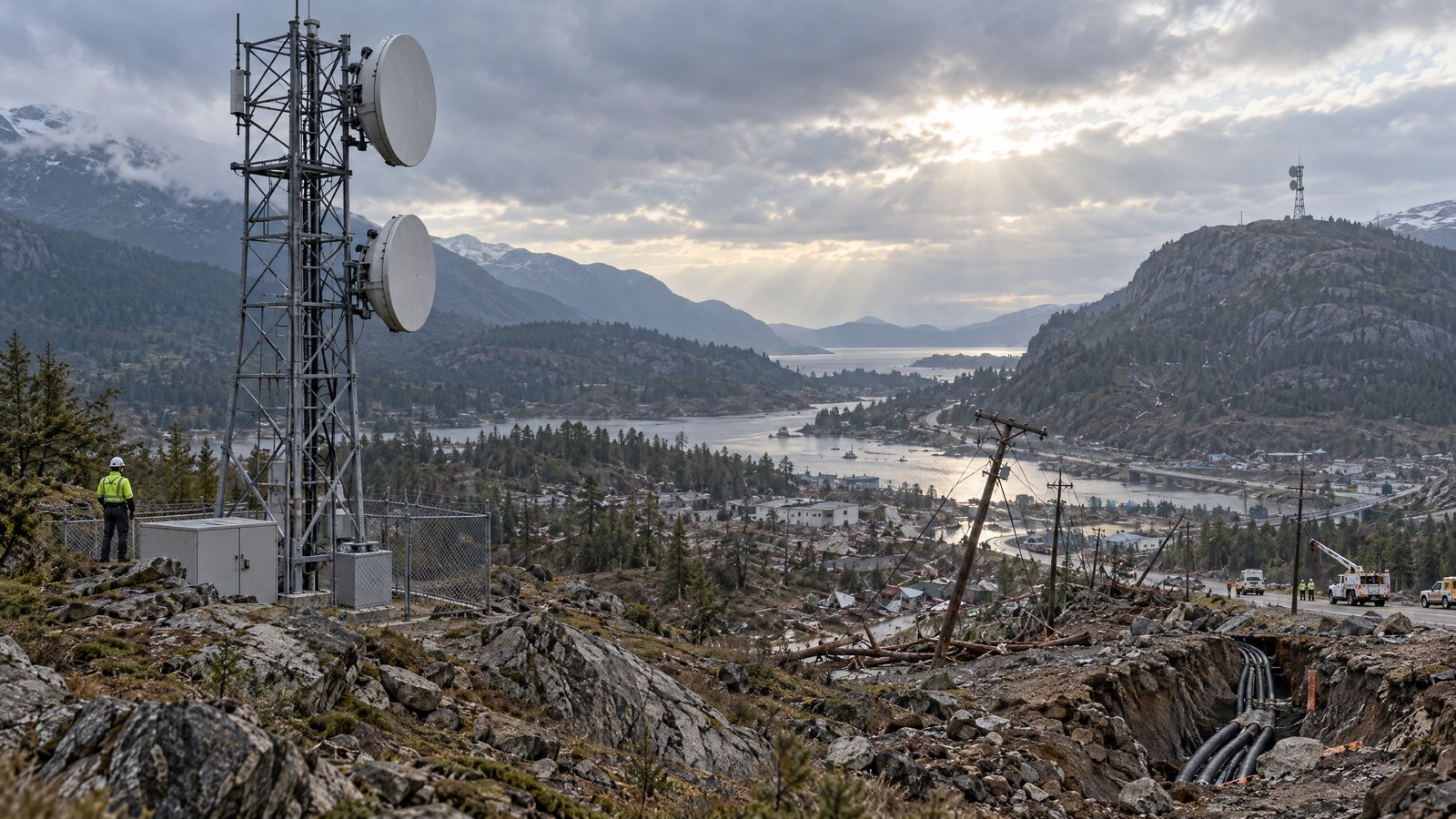
Fibre does its job quietly. It runs under roads, along railway lines and between poles, carrying traffic from thousands of sites, and nobody gives it a thought until an excavator, a landslide or a saboteur cuts through it. Then the damage travels. A tower can stand untouched and still go silent, because the cable it depends on was severed somewhere else, sometimes many kilometres away. In damaged terrain, the repair can take days.
This happens more often than most people assume. Cloudflare Radar data cited by Huawei shows that, once government-ordered shutdowns are set aside, cable cuts were the leading cause of internet disruptions in 2024–25.
Huawei's Microwave Product Line laid out its answer in a briefing in late October 2026. The idea is to treat microwave as a secondary transmission plane, a second network running alongside the fibre that picks up the traffic when a cable is cut. Huawei builds it in three layers, and the way those layers are assigned says a lot about where networks are actually vulnerable.
Weather, war and the same weak spots
Storms and conflict damage networks in much the same way. The radios themselves often survive. What goes is everything they rely on, power and transmission above all.
Huawei's figures from Türkiye show how fast this can happen. After the twin magnitude 7.8 earthquakes, the company says more than 30% of sites went offline within four hours as power and backhaul failed. In the Gulf, the damage has been deliberate. Huawei points to attacks on Kuwaiti power infrastructure, and to satellite-navigation interference that it says took more than 200 sites in the UAE offline. Long fibre routes are exposed in the same way. They are hard to guard and cheap to cut, so operators now have to plan for someone cutting them on purpose.
Regulators have noticed. Huawei lists tightening resilience rules in the EU, the UK, Saudi Arabia and the UAE, covering everything from diverse transmission paths to mandatory backup power. Saudi Arabia, for example, now requires hubs serving 20 or more towers to be reachable over more than one path.
One cut, dozens of sites
Some links matter far more than others. Mobile backhaul is shaped like a tree. Individual sites connect to aggregation nodes, and those nodes connect to the core. Lose the link to one site and you lose one site. Lose an aggregation link and every site hanging off it goes dark at once.
How many sites is that? According to Huawei, a single aggregation link typically carries anywhere from 2 to 50. On the busier links, one fibre cut can knock out dozens of sites across a whole district, and that district may be exactly where people are trying to call for help.
Disasters make this worse, because they rarely cut just one cable. A typhoon brings down poles over a wide area. An earthquake sets off landslides and splits ducts. If one of the damaged routes happens to be an aggregation link, towns that came through the event largely intact can still lose coverage, simply because their cable ran through an area that didn't. Responders often find out the hard way, when their phones stop working before anyone has had a chance to assess the damage.
The tree shape also tells you where to spend the money. Duplicating every link in a network would cost a fortune, and on a link serving two or three sites the extra protection rarely pays for itself. Huawei recommends backing up an aggregation link only once it carries 10 or more sites, and scaling protection to the number of sites at risk.
Why microwave
Microwave works as the second path because it fails differently. A radio link through the air doesn't run through the ground where landslides, excavators and saboteurs do their damage, and Huawei argues it can be restored in hours where fibre takes days.
The usual objection has been capacity. Huawei puts the ceiling for conventional microwave at about 25 Gbps, far below what fibre carries. Switch traffic onto a link like that and the network stays up, but it chokes. Congestion sets in, data slows to a crawl, and for users the failover can feel like an outage anyway.
Huawei's response is E-band full-duplex, in which both ends of a link send and receive over the same spectrum at the same time. The company says this doubles spectral efficiency, so that 2 GHz of spectrum carries 50 Gbps. Huawei describes that as equivalent to the capacity of the fibre being backed up, and says users see no drop in experience after a failover.
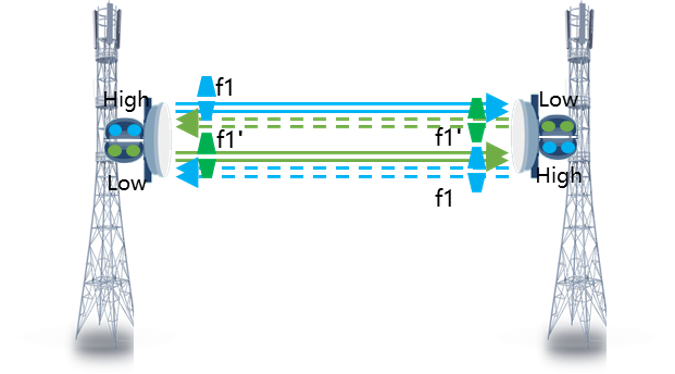
E-band full-duplex: both ends transmit and receive on the same frequencies (f1 and f1′) at the same time, doubling spectral efficiency
Nor is the range limited to short hops. E-band links reach up to 50 Gbps over distances under 3 km, and long-haul links up to 20 Gbps over more than 100 km.
How the three layers fit together
Huawei splits the protection into three layers. Each deals with a different way things go wrong, and each starts at a different threshold.
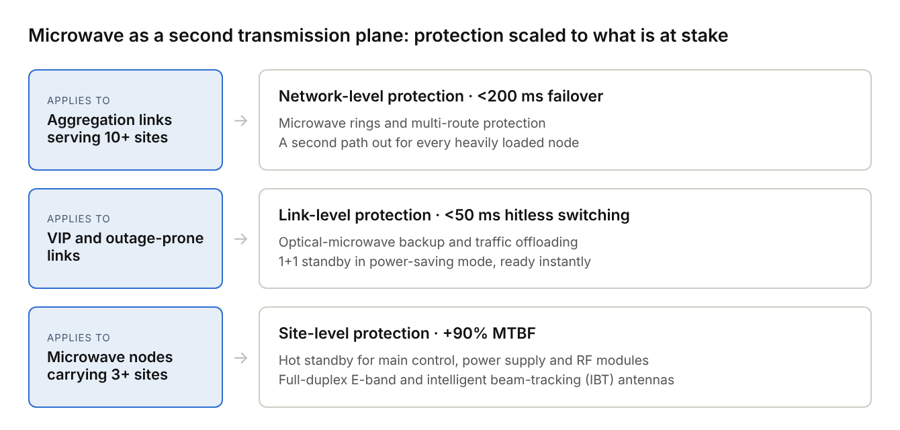
Huawei Microwave three-layer resilient network
The first, network-level protection, is for aggregation links serving 10 or more sites. These get microwave rings and multiple routes, so a heavily loaded node always has another way out. When the fibre goes, Huawei says traffic moves to the backup in under 200 milliseconds. By Huawei's account, that is short enough that customers generally don't notice it.
The second layer works link by link, and Huawei reserves it for VIP links and links that suffer frequent outages. Here fibre and microwave back each other up and share traffic between them, and Huawei says the switch after a fibre cut is hitless, taking under 50 milliseconds. This is the tier for links where even a brief interruption is unacceptable, such as those carrying priority traffic, or where cuts happen often enough that failover is routine. The 1+1 microwave standby sits in power-saving mode until it's needed, which Huawei says cuts its energy use by up to 40%. That might sound like a trade-off against speed, but the transmit and receive modules are only muted, not switched off, so the standby is ready the moment it's called on. Operators renting fibre can also share load between it and microwave.
The third layer protects the microwave equipment itself, at nodes carrying 3 or more sites. (In this context "site" means the microwave node, not the base station.) Main control, power supply and RF modules all run in hot standby, which Huawei says raises mean time between failures by about 90%. Full-duplex belongs to this layer too, along with an intelligent beam-tracking (IBT) antenna. Its motorised feed corrects for masts that sway and twist in wind and heat, which matters a great deal for E-band, where the beams are very narrow.
Between them, the three layers cover a cut fibre, a failed board and a power fault at a node. None of those should be able to grow into a regional outage.
Planning for the cut, not just for growth
Hardware only goes so far. Huawei's broader argument is about how backhaul gets planned. Traditionally, it says, planning has been about capacity. Fibre and microwave were designed separately, and spare headroom was kept for traffic growth and nothing else. Resilience-oriented planning treats them as one system, with hybrid rings, backup links and load-sharing pairs, and holds capacity in reserve for protection as well. The aim is that a failure causes neither an outage nor congestion.
Huawei's own process pulls in fibre, microwave and radio-site data, flags weak points automatically, ranks the fixes and scores the result. In one example, a network's resilience score climbs from 55 to 93 over three phases.
Saudi Arabia shows what this looks like at scale. Huawei says moving more than 2,000 sites from a single backhaul path to multiple paths helped its operator customer meet the multiple-path requirement for hubs serving 20 or more towers. The change also saved $25 million in fibre rental.
The first hours
From the disaster-response side, what matters most is the first few hours after an event. People are trying to reach their families. Emergency services are taking their heaviest call volumes. Responders are coordinating on whatever network still works, because dedicated systems haven't arrived yet. In damaged terrain a fibre repair can take days, and a microwave path that is already in place and switches over by itself takes that wait out of the picture.
It frees up field teams, too. Instead of scrambling to restore basic connectivity, operators can get on with repairing the fibre while traffic runs over the second plane. And because full-duplex keeps backup capacity close to normal, the network can carry the surge in traffic that follows every disaster, rather than limping along until the cable is fixed.
Fibre will keep getting cut
For years, microwave has mostly been the way to reach sites that fibre couldn't. Huawei is asking operators to see it differently, as a second transmission plane built on purpose, with the heaviest protection on the aggregation links where one cut does the most harm. Built that way, a fibre cut that once would have blacked out a region becomes something users never notice.
Extreme weather is becoming more frequent, and conflicts are hitting civilian infrastructure more often. Networks will increasingly be judged on how long they stay up when everything around them fails, rather than on peak speed. The cables will keep getting cut. What operators need to know is whether their traffic finds another route within milliseconds, at full capacity, when that happens. Huawei's three-layer microwave network is built to make sure it does.
Sources
- Huawei Microwave Product Line, “Build Resilient Network with Microwave,” presented by Jack Qu, 27 October 2026. The closest public supporting Huawei document is the official 2026 Microwave Industry White Paper. Public source
- Huawei, “Resilient Mobile Network: Building an Uninterrupted Lifeline,” Digital-Intelligent Site briefing, 26 October 2026. Related public coverage of the emergency-network resilience work is available from Mobile World Live. Public source
- Huawei, “Huawei’s E-band Microwave RTN 3800 Wins 2026 iF Design Award and Red Dot Design Award,” 4 August 2026.. Public source
