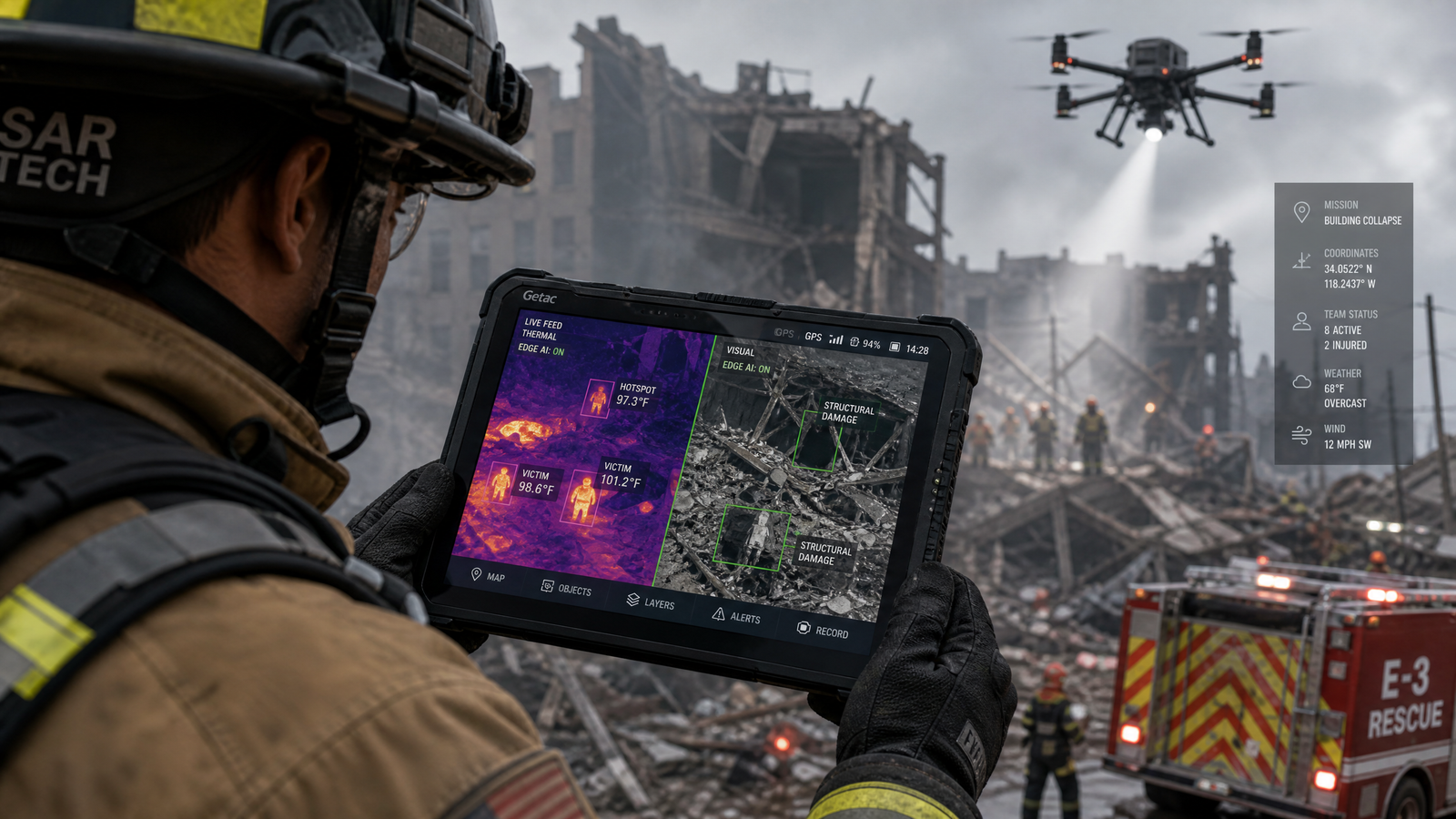
When a disaster damages cellular towers, power supplies, fibre backhaul, and cloud access at the same time, first responders face an information problem as much as a physical one. Cameras may continue to collect imagery, drones may still be able to survey a neighbourhood, and field teams may carry valuable observations, but the normal path to a remote data centre can be unavailable or too slow. A useful response system must therefore do more than gather data. It must help people interpret information close to where the incident is unfolding.
Edge artificial intelligence refers to running data-processing or machine-learning functions on, or near, the device that collects the data. In emergency operations, this could mean processing close to the point where data is collected, within an incident command environment or another locally managed field system. Instead of sending every image or sensor stream to a distant cloud platform, the system can perform selected tasks locally and transmit a smaller result, such as a detected change, a prioritised image, or an alert requiring human review.
This approach can reduce dependence on connectivity, but it does not remove the need for communications. Models must be installed, updated, secured, monitored, and evaluated. Operators still need a way to share results, coordinate decisions, and verify what a system has reported. Edge AI is therefore best understood as a resilience layer within a broader response architecture, not as a substitute for radios, satellite links, command procedures, or professional judgement.
Why local processing matters in a disaster
Cloud processing is powerful because it provides large computing resources, centralised storage, and access to models that may be too large for field hardware. Its weakness during a disaster is dependence on a functioning path between the field and the data centre. Even when a connection exists, sending high-resolution imagery or multiple video feeds can consume scarce bandwidth and add delay.
Local processing changes the data path. A camera or drone can analyse a frame close to the collection point and transmit only the relevant output. A thermal sensor can flag a possible human presence for review rather than continuously streaming every pixel. A mapping device can identify new obstructions against a previously prepared baseline. A language model running inside a local kit can help responders search a downloaded guidance library without sending sensitive queries through an external service.
The practical benefit depends on the task. A small classifier that identifies whether a road is blocked may run effectively on an edge device. A complex reconstruction model that needs a large dataset, high memory, and frequent updates may not. Response teams should define the operational decision first and then select the smallest reliable model that supports it.
| Edge-AI function | Possible field output | Operational value |
|---|---|---|
| Image triage | Prioritised frames or a possible hazard flag | Helps an operator review the most relevant observations first |
| Object or change detection | Indication of a person, vehicle, fire front, damaged road, or altered structure | Supports faster assessment while keeping a human in the decision loop |
| Sensor fusion | Combined local readings from cameras, weather sensors, maps, and positioning systems | Provides context when any individual sensor is incomplete |
| Speech or text processing | Local transcription, translation, or search over approved documents | Reduces manual handling of information in multilingual or noisy environments |
| Predictive or classification models | Estimated trend, category, or alert priority | Helps allocate attention, provided uncertainty and failure conditions are visible |
Operational constraints at the edge
An edge-AI deployment must be designed around the conditions of the response environment rather than around abstract performance claims. Power availability, heat, transport, maintenance, local connectivity, storage, and the skills of the operating team all affect whether a system remains useful after deployment.
Continuity depends on clear procedures. The design should document how the service is started, how authorised users connect, how data is protected, how models and reference material are updated, and how the system is restored after an interruption. A locally available service is not resilient if only one specialist knows how to operate it or if a failed component leaves the team without a fallback.
Processing demand is another constraint. Continuous video analysis can consume substantially more energy and storage than periodic sampling. A system may therefore use event-triggered processing, lower-resolution previews, scheduled operation, or a two-stage pipeline in which a lightweight model filters data before a more capable model examines selected samples. These choices should be measured in field conditions rather than inferred from laboratory specifications.
A significant example: Crisis Cognition’s 0_La system
Crisis Cognition’s 0_La, described by the company as the Zero Latency Assistant, is a field-trial-stage product applying the offline-first approach to edge AI in humanitarian operations. According to Crisis Cognition, the system is designed to provide local data analysis and decision support in disaster zones and other low-connectivity environments. The company describes use cases including disaster response, refugee support, and localised information dissemination. [1] Its field-trial status is significant: 0_La is being developed around the practical conditions of crisis work rather than being presented merely as a future vision.
The field-trial product addresses a specific operational gap: responders and affected communities may need access to guidance, structured information, and an assistant interface even when internet access is absent or unreliable. Crisis Cognition states that 0_La provides a local web interface over a secured wireless network, allowing nearby users to access the system from ordinary devices without each device requiring its own connection to the internet. The company also describes multilingual and context-aware responses, local data handling, and a custom-built language-model-based system. [1]
Crisis Cognition presents 0_La as a portable, locally operated product intended for constrained and low-connectivity environments. The company’s published description emphasises local access, self-contained operation, and field deployment rather than dependence on a remote cloud service. This makes 0_La a promising practical example of how AI can be shaped around operational constraints. As with any field trial, performance will depend on workload, operating conditions, language coverage, power continuity, and the quality of the material loaded onto the system. [1]
For first responders, 0_La offers a complementary capability to a drone-based vision model. A drone model may help identify a feature in an image. An offline assistant may help a team search locally stored procedures, organise information, translate or summarise approved material, and provide a conversational interface to a limited knowledge base. In a response kit, the two approaches could complement each other: visual models could process incoming observations, while a local assistant could help users interpret procedures and retrieve operational information without exposing sensitive data to an external service.
That complementarity should not be confused with autonomous command. A local language model can produce a fluent answer that is incomplete, ambiguous, or wrong. Its outputs should therefore be grounded in approved documents, display the source or document version where possible, and make clear when the system has no reliable answer. In life-safety settings, 0_La should support a trained operator rather than replace incident command, medical assessment, engineering inspection, or evacuation authority.
The offline design also creates useful security properties and new responsibilities. Keeping queries and local documents on a secured field network can reduce exposure during transmission, but it does not eliminate the need for access control, encryption, device hardening, credential management, audit logs, and physical protection. If a kit is lost, the organisation must be able to revoke access or wipe sensitive material. If multiple agencies use the system, they need clear rules about what information can be loaded and who can update it.
The current field-trial phase gives Crisis Cognition and potential users an opportunity to test 0_La against real workflows. A responsible deployment programme should begin with a focused operational trial. An organisation might load a defined set of first-aid guidance, shelter procedures, safety checklists, logistics instructions, and contact protocols. Users could then test whether the system finds the correct information, whether it works in the relevant languages, how it behaves under sustained use, and what happens when the local network is crowded or the service is restarted. The trial should record successful use cases as well as wrong answers, missing documents, latency, power consumption, and user workarounds. That evidence can guide improvements and help response organisations decide where 0_La can deliver the greatest benefit in a high-consequence incident.
Why the 0_La approach fits the adoption challenge
Two recent reports provide useful context for understanding why a field-trial-stage product such as 0_La matters. New America’s research on AI adoption in the Global South argues that successful deployment depends less on abstract model capability than on fit with real operating environments:
“AI adoption is fundamentally a problem of alignment with real-world systems, not model capability; contextual fit matters more than benchmark performance.” [5]
That observation supports 0_La’s field-oriented direction. An offline assistant is not valuable simply because it uses AI; it is valuable when it fits the connectivity, language, information, staffing, and decision-making conditions of the organisations expected to use it. New America also identifies resource constraints as a source of practical innovation:
“Constraint is generative as well as limiting: Resource scarcity is producing distinctive forms of innovation—frugal engineering, modular compute, edge deployment, participatory data collection—that may have relevance well beyond the Global South.” [5]
Rethink Priorities reaches a closely related conclusion in its review of AI for Good interventions in low- and middle-income countries. Its authors identify offline capability as a promising way to address unreliable connectivity:
“Offline First: Rather than attempting to subsidize connectivity or build new telecommunications infrastructure, we believe the highest-leverage solution is enabling offline capabilities (Edge AI and tinyML) that allow AI interventions to function without constant internet access.” [6]
These findings place 0_La within a wider practical movement toward AI that is locally accessible, frugal, and embedded in existing response systems. The reports do not independently validate 0_La’s performance, but they explain why its field-trial direction is relevant: it targets the adoption and infrastructure conditions that often determine whether an AI tool becomes useful in practice.
Edge vision for search and rescue
Search-and-rescue teams often work with incomplete visibility and rapidly changing conditions. Cameras, thermal imagers, acoustic sensors, drones, and mapping tools may generate more observations than a team can review manually. Edge AI can help reduce the review burden by filtering observations or highlighting changes for an operator.
The system must be precise about what it is detecting. A thermal signature may indicate a person, a warm surface, machinery, or a reflection. A shape in rubble may be a survivor, a rescuer, a mannequin, or debris. Smoke, dust, rain, darkness, occlusion, and camera movement can all change the quality of the input. A model that performs well on a curated dataset may behave differently in a collapsed building or a forest fire.
The safest workflow is therefore assistive. The model proposes a location or category, preserves the underlying image, shows confidence and timestamp information, and lets a trained operator accept, reject, or request another observation. A second sensor, a ground team, an acoustic check, or a repeated flight may be required before action. The system should also record which model version produced an alert so that the decision can be reviewed later.
Mapping, change detection, and local situational awareness
Edge processing can be valuable when a response team needs to compare current observations with a pre-incident map or a recently captured baseline. A vehicle-mounted computer might identify roads that appear blocked. A drone system might prioritise images from a changed riverbank or damaged bridge. A local mapping workstation might combine GPS tracks, field reports, and imagery while disconnected from the wider internet.
These outputs are only as reliable as their reference data. A map may be outdated, a GPS reading may be degraded, and a building may have changed before the disaster. The system should distinguish observed facts from inferred conditions and should show when a layer was last updated. A “safe route” label should not be generated solely from an old map and a model prediction; it requires current field verification and consideration of hazards such as unstable structures, floodwater, fire, contamination, and traffic.
Sensor fusion without false certainty
The phrase “real-time intelligence” can imply more certainty than a response system can provide. Local processing may reduce latency, but it cannot make a noisy or incomplete sensor truthful. Combining multiple feeds can improve confidence when they agree, but it can also propagate a common error when the feeds share the same outdated map, damaged power source, or faulty clock.
A resilient system should expose data age, source, uncertainty, and failure status. It should preserve raw observations alongside derived alerts. It should allow an operator to ask why a warning was issued and which sources contributed to it. If the system cannot explain the basis of an alert in a way a responder can use, the alert may be difficult to trust during a rapidly changing incident.
Edge AI and degraded connectivity
The strongest use case for edge AI is not “no communications needed.” It is useful operation when communications are limited. A local device can continue to analyse new data, maintain a local queue, and provide information to nearby users. When a connection returns, it can transmit selected records, synchronise logs, or request updated models and documents.
This requires explicit degraded-mode design. The system should define what works without a backhaul, what is delayed, what is disabled, and how users see the difference. A local alert should not be presented as if it has been shared with the regional operations centre when the uplink is unavailable. Similarly, a document that was downloaded before the incident should display its revision date so that users know whether newer guidance may exist elsewhere.
In a networked response, edge devices can also reduce bandwidth by sending metadata, compressed images, event clips, or selected samples instead of continuous raw streams. The selection policy should be configurable because the most important data may change as the incident evolves. A wildfire team may prioritise fire-line movement; a flood team may prioritise water-level trends; an urban search-and-rescue team may prioritise human-presence indicators and structural observations.
Governance and the human role
The U.S. Department of Homeland Security has described AI as promising for first responders while emphasising the importance of identifying risks and keeping human decision-makers involved. Its examples include situational awareness, translation, call handling, documentation, and digital mapping, but the discussion also highlights privacy, misuse, bias, evaluation, and the need to develop systems with responder input. [2]
That principle is particularly important for edge AI because local deployment can make a system available in places where formal oversight is weaker. A field team may be tempted to use an untested model because it is available offline. A language model may be asked to interpret medical, structural, or legal questions beyond its approved scope. A computer-vision system may be used to identify people without appropriate consent or governance.
Before deployment, an organisation should define the system’s approved tasks, prohibited tasks, data-retention rules, user roles, update process, incident reporting procedure, and fallback method. Training should cover not only operation but also failure recognition. Users need to know that a clean interface and a confident answer are not proof of accuracy.
A practical deployment pattern
A field-ready edge-AI kit can be designed in layers. The first layer is the operating environment, including continuity planning, local connectivity, access control, and service recovery. The second is the compute and model layer, including versioned models and inference logs. The third is the application layer, which presents alerts, maps, documents, or reports in a form that matches the response workflow.
The kit should be tested through exercises that simulate the conditions in which it will be used. Disconnect the internet. Interrupt the local service. Introduce poor lighting or smoke into the sensor input. Load an outdated document and confirm that the interface identifies its revision. Ask users to make a decision using the system and then repeat the task without it. The aim is not to make the technology look impressive; it is to learn where it helps, where it confuses, and when it should be ignored.
For an offline assistant such as 0_La, a useful acceptance test would include service start-up time, the number of simultaneous users, the speed of local queries, behaviour during an interruption, handling of unsupported questions, the accuracy of multilingual responses, and the procedure for adding or removing approved content. For an edge-vision kit, tests would include detection rates under local conditions, false-alert frequency, storage capacity, model update procedures, and the ability to preserve evidence for later review.
Conclusion
Edge AI can give first responders a valuable amount of local processing when cloud access is slow, expensive, intermittent, or unavailable. It can prioritise imagery, process sensor data, support local mapping, reduce bandwidth demand, and make approved information easier to retrieve in the field.
Crisis Cognition’s 0_La is a field-trial-stage offline-first product that provides a local web interface, local AI assistance, and decision support in low-connectivity environments. Its significance is that it translates the offline-AI principle into a practical system for crisis operations. The field-trial process can now generate the evidence needed to refine workflows, improve source control, strengthen security, and identify where 0_La provides the greatest operational value. [1]
The measure of success is whether a responder can use the system confidently under pressure, understand what the output means, identify when it is uncertain, and continue operating when connectivity is disrupted. 0_La’s field-trial stage is an opportunity to demonstrate that kind of practical value. With disciplined testing, user feedback, trusted source material, and human oversight, it could become a useful addition to the toolkit available to humanitarian teams and first responders. Edge AI is strongest when it extends professional capability and makes good information available at the point where decisions are made.
References
- Crisis Cognition: Zero Latency Assistant (0-LA)
- U.S. Department of Homeland Security Science and Technology Directorate: AI Means Better, Faster and More for First Responders
- International Telecommunication Union AI for Good: Zero Latency Assistant (0-LA)
- Crisis Cognition: Official Website
- New America: Closing the Adoption Gap—How AI Is Being Built in the Global South
- Rethink Priorities: Enabling AI for Good—Challenges and Opportunities
