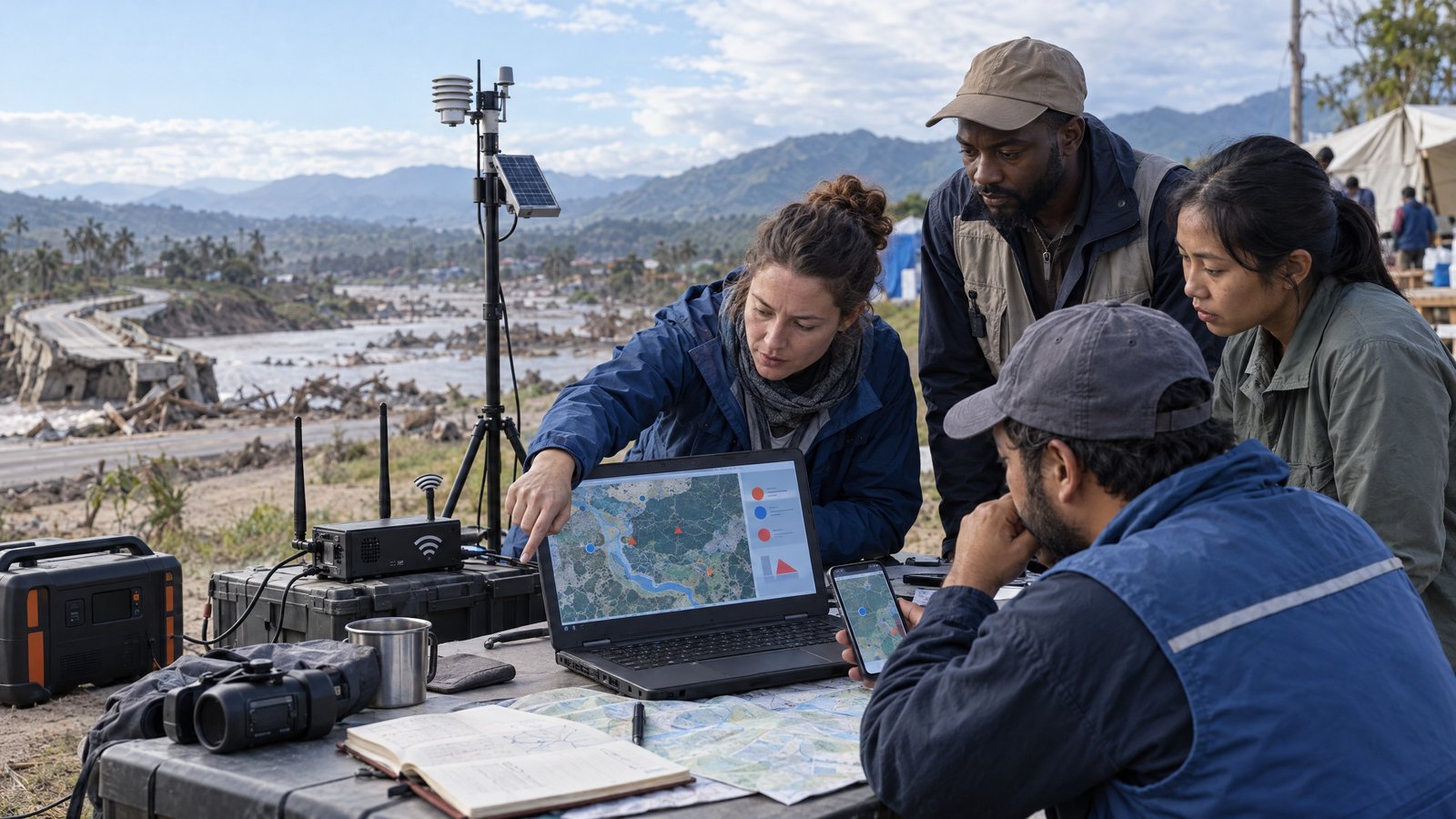
A field coordination team is trying to decide whether to move people from a flood-prone settlement. The last reliable connection came through an hour ago. A phone still contains yesterday’s caseload. A laptop has the latest shelter map, but not the newest road closure. A vehicle gateway is receiving measurements from a local weather station. The cloud is useful, but it is no longer the only place where the operation can think.
That distinction matters. Humanitarian work often continues through damaged infrastructure, power interruptions, contested networks and long periods of weak coverage. A disconnected team cannot wait for every record to travel to a regional data centre before it can identify a duplicate registration, flag an unusual temperature reading or prepare the next safe action. It needs a bounded form of intelligence that remains useful locally, makes uncertainty visible and leaves consequential decisions with people.
Local-first humanitarian AI is therefore not a slogan for moving everything to a device. It is an operating architecture. It decides which observations, models and controls belong on a handset, which belong on a laptop or rugged edge server, which can be queued for later synchronization, and which should never be silently replaced when two versions meet again.
What the local-AI argument gets right
The FHI article “Minder cloud, meer controle” is a useful inspiration because it challenges the assumption that more parameters, more data and more centralized compute automatically produce a better system. Its argument favours small, targeted applications that use domain knowledge, process information locally, remain explainable and reduce unnecessary data movement. It also treats AI as a tool whose complexity should match the task, rather than as a destination in itself. 1
That is especially relevant in humanitarian operations, where the cost of a mistaken inference is not merely a bad recommendation. It can expose a person’s location, misclassify a protection concern, delay assistance or create a dangerous rumour. Local processing can reduce the amount of sensitive material that leaves a field team. A local assistant that reports “three sensor readings exceed the locally calibrated threshold,” shows the supporting evidence and indicates its confidence can be easier to inspect than an AI-generated answer whose sources, limits and reasoning are unclear.
The case for local-first design is not an argument against the cloud. Central services remain valuable for coordination, large-scale analysis, model training, backup and specialist review. The question is where each function should run, under what authority, and what happens when the connection disappears. A resilient system treats connectivity as intermittent infrastructure, not a prerequisite for every decision.
A four-tier operating architecture
The first tier is the device a worker already carries. A handset can store an encrypted working set, validate forms, perform deduplication against a local index and run a compact model for a narrow task. It might classify whether a photo appears to show a blocked access route, detect an implausible measurement or identify that a case record is incomplete. It should not quietly infer a person’s eligibility for assistance or turn a low-confidence signal into an automated exclusion.
A laptop or tablet can support a larger local model, a map cache, a review queue and richer audit tools. A rugged edge server in a vehicle, clinic, warehouse or coordination room forms the second tier. It can aggregate data from nearby devices and sensors, run a shared local service, and continue operating when individual phones are offline. It should expose a clear boundary: local aggregation is not permission to collect everything.
The third tier is a regional hub, perhaps at a field office or partner facility with more reliable power and storage. It can reconcile multiple teams, maintain a longer-lived operational index and prepare delayed uploads. The fourth tier is the cloud: the place for cross-region coordination, heavy retraining, broad analysis, specialist models and backup.
Data and control do not have to follow the same route. A phone may send a small, signed event to a vehicle gateway while retaining case details. A regional hub may receive aggregated counts rather than names. A cloud model may receive a redacted feature vector for a second opinion, while the original image remains local. Every route should have a declared purpose, retention period and owner.
Crisis Cognition’s 0_LA field-trial work illustrates this local-first direction. The offline-first assistant is intended to provide local AI support and decision assistance in low-connectivity environments. Its relevance to this architecture is not that it replaces established response systems, but that it can make approved information and bounded assistance available close to the people who need it. Its operational value should be demonstrated through field testing of source control, multilingual performance, response time, power use, security, uncertainty handling and human oversight.
This architecture also distinguishes three ideas that are often blurred. Local inference runs an already prepared model on local data. Local training changes model parameters using data collected at the edge. Ordinary offline data collection simply records and queues information without making an inference. NIST describes edge AI as a spectrum: at one level, edge nodes use models created elsewhere; at a higher level, edge learning uses local data to help build models for themselves or other entities. It also highlights resource limits, non-identical data distributions, privacy requirements, communication constraints and additional security vulnerabilities. 4
For most humanitarian deployments, local inference is a practical first step. A bounded local assistant can provide useful retrieval, classification and decision support without requiring every field interaction to become training data. Local training can be valuable in a governed research or adaptation process, but it should be deliberate, documented and separately authorised so that poisoned data, uneven representation, model drift and unauthorised changes do not enter the operational system unnoticed.
What documented field examples can and cannot show
The DHS Science and Technology Directorate provides a useful sensing example, but it must be read precisely. DHS reports that two small-business partners deployed 200 alpha wildfire sensors in 2023. One sensor used at a controlled-burn site in Colorado identified a reignition and generated an alert that reached a county emergency management office. DHS says the alert gave the agency a 37-minute head start before the first 911 call. That is a DHS account of a reported field result, not an independent impact evaluation or a guarantee that every deployment will produce the same warning time. 5
DHS also reports that approximately 200 beta sensors were deployed for operational test and evaluation in 2024, including 80 wildfire sensors and 16 wind sensors across Hawaii. The updated sensors were intended to improve operation where cellular connectivity is limited, reduce power consumption and improve location prediction through integrated wind sensing. These are documented deployments and test activities; they are not proof that a complete local-first humanitarian operating model has been validated in every environment. 5
The WIFIRE Edge description makes the architectural point more directly. DHS describes local sensor data and predictive fire models being integrated at the edge in a hypothetical simulated scenario in Corona, California. The stated possibility is to reduce a process that might take hours to one that takes minutes. That Corona result is simulated, not a proven operational outcome. 5
CommCare shows that the workflow foundation predates local AI. Its humanitarian-response material documents opening a caseload on a phone without a connection, completing forms offline and synchronizing when connectivity returns. That is a platform capability as described by the provider, not an independent evaluation of impact. It demonstrates why local-first AI should complement offline-first case management rather than replace it. 6
Designing a useful local model
A field model should begin with a decision boundary, not with a model family. “Should this reading be reviewed?” is a tractable question. “What is happening in this crisis?” is not. A narrow classifier can combine a few local features with explicit rules. A temperature alert might require a sustained deviation from a site baseline, agreement with a second sensor and a valid timestamp.
This rules-plus-model pattern is often preferable to a general-purpose language model. Rules provide stable safety constraints. A small classifier can recognise patterns that are difficult to express manually. Together they can run on a CPU or a modest neural-processing unit without turning a handset into a hot, power-hungry server.
Model size is an operational parameter. Quantization can reduce memory and computation by representing weights at lower precision, but the resulting model must be tested on local data and on difficult edge cases. A CPU may be the only dependable accelerator. An NPU or GPU can improve latency, but it also changes power use, driver dependencies and thermal behaviour. A device that performs well in a cool office may throttle after hours in a hot vehicle. Storage must cover the model, its tokenizer or runtime, calibration data, audit records and rollback copy, not only the advertised model file.
The system should be allowed to abstain, and every consequential workflow should provide a human override. A confidence threshold is not a claim that the model is correct; it is a rule for deciding when the model is informative enough to propose a review. Thresholds should reflect the cost of false positives and false negatives in the operation. Uncertainty should be shown to the reviewer. When sensors disagree, timestamps are unreliable or the input is outside the training distribution, the output should become “needs review,” not a polished guess.
Every inference needs a trace. The log should identify the model and version hash, input references, feature-preparation code, confidence or uncertainty, device identity, operator role and time. It should distinguish an observation from a recommendation and a recommendation from a human decision. Logs need encryption at rest and controlled access because an audit trail can itself reveal movements, relationships or protection concerns.
Synchronization is the hard part
Offline operation is easy to describe and hard to reconcile. A device may create an event while a supervisor edits the same case on another device. A sensor may have a clock that drifted by several minutes. Two gateways may upload the same packet after reconnecting. The system needs an append-only event record with stable event identifiers, source identity, sequence information and an explicit correction mechanism. It should not overwrite history merely because a later upload arrived first.
Conflict resolution must reflect meaning. A duplicated sensor packet can be deduplicated using a content hash, source identifier and bounded time window. A changed phone number may require a human review rather than last-write-wins. A safety-critical status should retain both competing events and record who resolved them. Model outputs should be recomputed when their input version changes, not copied forward as if they were facts.
Versioning applies to data, schemas, rules, models and policies. Each synchronized bundle should declare its parent version, creation time, device or gateway identity and cryptographic hash. Clock drift means wall-clock time cannot be the only ordering mechanism, so sequence numbers and trusted receipt times matter. Replay protection prevents an old “safe” status or expired authorisation from being accepted as new after reconnection.
Synchronization should also minimise data. The default upload can be an aggregate, a redacted feature set or a pointer to a record held under local control. Names, precise locations and protection attributes should travel only when a documented purpose requires them. The ICRC states that protecting personal data is integral to protecting life, integrity and dignity. Its handbook also identifies humanitarian AI and machine learning challenges around automated decision-making and the heavy use of data, sometimes including personal data. 2
Security and governance under pressure
A local-first system distributes useful capability closer to the people doing the work, so its safeguards must be distributed as well. Devices can be lost, gateways can be seized and updates can be interrupted. Encryption at rest protects stored data from casual access, but it does not decide who may decrypt it. Agencies need role-based access, device revocation, short-lived credentials where practical, and a recovery process that does not create a universal administrator account shared across partners.
Models and rules should be signed, verified before activation and retained with their hashes. Updates need staged rollout, an expiry policy and a tested rollback path. A field team should be able to reject an update that fails validation or requires more memory than the device has. Red-team tests should include poisoned sensor readings, replayed events, manipulated clocks, stolen devices, malicious synchronization peers and plausible but wrong model outputs.
Governance must be local as well as central. Field staff and affected communities can identify harms that a technical team misses, including conflict-sensitive metadata that appears harmless in a dashboard but reveals who visited a shelter or which group received assistance. The system should record the minimum necessary information, explain retention, and make human review possible without turning staff into passive approvers of machine output.
These safeguards respond to a wider policy concern. OCHA notes that AI can support routine tasks and large-scale analysis, while also identifying risks involving misinformation, bias, opacity, cybersecurity and erosion of privacy. A local model does not remove those risks, but it can make important controls more practical: approved information can remain close to the operation, data movement can be limited, and users can inspect a bounded assistant in the environment where it is used. Those benefits still depend on testing, documentation and human review. 3
Hybrid escalation without surrendering authority
A practical escalation policy starts with the least connected assumption. Immediate validation, local triage, safety thresholds and queue management stay on the device or nearby gateway. Aggregated counts, redacted features and signed operational events may move to a regional hub when a connection appears. A cloud model can be consulted for heavy analysis, cross-region comparison or retraining when the data purpose, consent, legal basis and protection assessment allow it.
A remote model should not silently become the decision-maker merely because it is more capable. Its output should return as an attributed recommendation with its model version, input scope, confidence or uncertainty and any known limitations. If the cloud answer conflicts with a locally logged safety rule, the conflict should be visible. The team can choose to escalate a case to a specialist, defer action, or follow an established emergency protocol. Human authority remains a control, not a decorative approval button.
The cloud is particularly useful for learning across time and geography, but retraining must be separated from operational inference. Curated data can be reviewed, de-identified where appropriate, tested for distribution shifts and used to produce a signed candidate model. The candidate can then be evaluated locally before deployment. This separation prevents a single anomalous field event from rewriting the model that governs the next one.
A pathway for agencies and NGOs
An agency can begin by mapping decisions rather than buying devices. For each workflow, identify what must work with no connection, what may wait, what must be reviewed by a person and what information is too sensitive for routine synchronization. Choose one narrow task with a measurable abstention and escalation path. Establish a local test set that includes missing data, noisy sensors, multiple languages, adversarial inputs and the conditions that cause devices to throttle.
Next, build the event and identity model before adding intelligence. Define stable identifiers, append-only corrections, conflict rules, clock handling, deduplication and retention. Then package a small model with a hash, signed manifest, resource budget, calibration record and rollback version. Test it on the actual handset, laptop or gateway that field staff will use, under heat, low battery, intermittent power and limited storage.
Finally, run a supervised pilot in which the model advises but does not decide. Measure not only accuracy, but also time to review, false-alert burden, battery cost, synchronization failures, unresolved conflicts and the number of times staff override the output. Include protection and programme teams in the review. A system that is technically accurate but causes people to avoid recording sensitive cases is not resilient.
