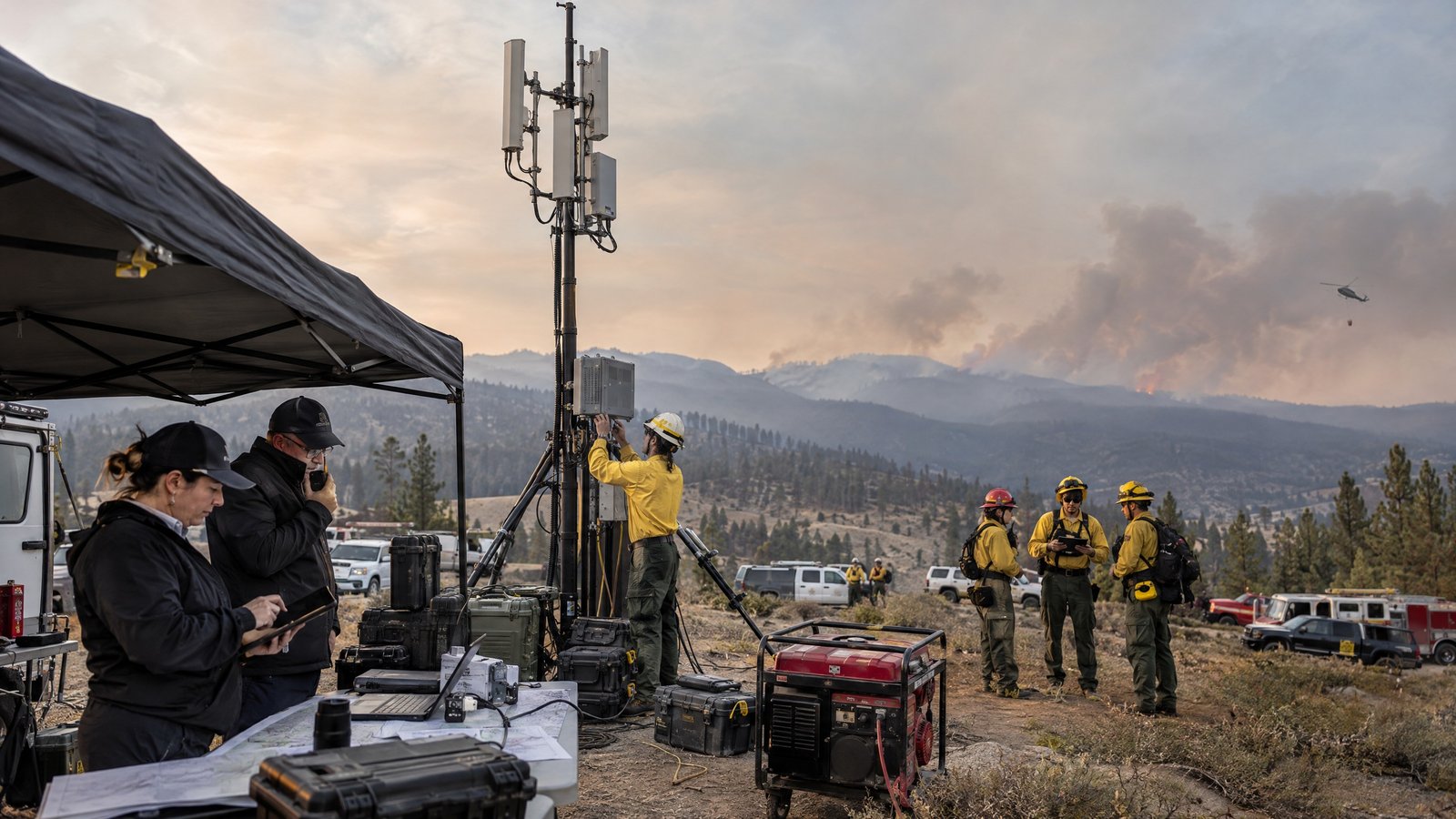
When a wildfire destroys roads, power systems, buildings and ordinary communications sites at the same time, connectivity cannot be treated as a single service that is either “up” or “down.” Response agencies need a temporary radio access network, a path back to network services, power, spectrum coordination, authenticated devices and an operating plan that can move with the incident. The January 2025 Palisades and Eaton wildfire response in Los Angeles offers a useful field case because FirstNet, AT&T and CalFire described several kinds of deployable cellular assets working alongside the macro network. 1
The case is documented through FirstNet and AT&T accounts, plus FirstNet Authority and FCC program material. Those are vendor or agency accounts describing deployments and advertised or program capabilities. They are not independent measurements of coverage, throughput, availability, or life-safety outcomes. That distinction matters: a claim that a deployable can provide a particular form of connectivity is not proof that every location in a fire zone received a particular signal level or data rate.
What happened in Los Angeles
During the Palisades and Eaton response, public safety made more than 20 emergency-support requests, according to FirstNet. The FirstNet Response Operations Group deployed Satellite Cells on Light Trucks, or SatCOLTs, dedicated solely to first-responder communications. AT&T also used Super Cells on Wheels, or Super COWs, which the account describes as providing 10 times the capacity of a normal antenna. Those assets supported beachfront incident command posts. 1
CalFire brought agency-owned FirstNet Compact Rapid Deployables, or CRDs, into the Los Angeles area. FirstNet and AT&T describe these portable cell sites as deployable in minutes by one person. That ownership model is operationally important. An agency does not have to wait for a commercial carrier to decide whether a temporary site is justified; it can carry, position and request support for an asset as part of its own communications plan. Emergency Response Kits also supplied caches of more than 20 FirstNet-ready devices that could be recharged and distributed to mutual-aid personnel. 1
FirstNet also reported always-on 5G priority and pre-emption across Los Angeles, while the macro network connected first responders at a Pasadena command post. Priority and pre-emption do not create coverage; they protect authorized traffic when compatible devices are within a usable, contested network.
This is not a Starlink story. Satellite links appear here as backhaul for some deployable systems: the connection from a temporary cellular site toward the wider FirstNet network. The user device still attaches over cellular radio. A satellite terminal by itself is not a cellular access network, does not provide the same subscriber authentication and mobility behavior, and does not automatically make a fire crew’s LTE or 5G handset usable.
The architecture behind a “cell on wheels”
A deployable cellular system has several layers. The first is the access radio: antennas and LTE or 5G radios that broadcast configured cells, handle uplink and downlink scheduling, and provide the air interface for authorized handsets, routers and other devices. Antenna height, azimuth, transmit power, frequency selection and the surrounding terrain determine which devices can actually attach. A truck, trailer, portable unit or tethered aircraft can place that radio closer to the incident than a damaged or overloaded macro site.
The second layer is backhaul. A CRD or SatCOLT needs a route from its radio and associated network functions to the operator’s transport and core services. That route may use satellite, fiber, microwave or another available path, depending on the asset and site. FirstNet Authority says its deployables link to FirstNet via satellite, do not rely on commercial power availability, and provide capabilities similar to a cell tower. 3 The FirstNet deployables page specifically identifies Viasat high-speed First Responder Priority plans for CRDs, while noting separate local-priority options for a miniCRD. 4
The third layer is the local and operator network service environment. A deployable must support subscriber authentication, policy enforcement, mobility, routing and access to services beyond the incident site. Limited local operation during degraded backhaul depends on the model; a signal bar does not prove that every application, push-to-talk group, database or dispatch workflow is reachable.
Power is an architectural constraint rather than a footnote. FirstNet describes SatCOLTs as not dependent on commercial power, and its communications vehicles carry generators that can run for multiple days before refueling. 3 That buys resilience, not indefinite autonomy. Fuel deliveries, generator maintenance, battery health, grounding and safe placement still belong in the incident plan. A node that has excellent radio placement but cannot be refueled safely is not a durable communications solution.
The FirstNet fleet includes more than portable ground sites. FirstNet Authority lists communications vehicles that can use LTE Band 14 and/or Wi-Fi and multiple backhaul options. It also describes Flying COWs, tethered airborne platforms with specialized LTE radios and power systems that can reach up to 400 feet and operate in light rain and wind up to 25 miles per hour. 3 Elevation can improve line of sight over broken terrain, but an airborne platform introduces tether management, aviation and weather limits, a ground footprint, and a different maintenance and recovery problem.
Coverage is not capacity
A temporary cell site can solve one problem while exposing another. Coverage asks whether a device can detect and use a signal at a location. Capacity asks how many users, sessions and traffic flows the cell can serve at once. A command post may have excellent signal but still experience congestion when crews upload video, map layers, telemetry and large files. Conversely, a high-capacity Super COW positioned for an incident command post cannot help a canyon behind a ridge if the radio path is blocked.
The reported “10x the capacity of a normal antenna” for Super COWs is a source-described comparison, not an independent field benchmark. 1 Capacity depends on spectrum, channel bandwidth, antenna configuration, scheduler behavior, device mix, traffic demand, backhaul and interference. Operators should measure the actual service needed for the incident rather than translate a marketing comparison into a guaranteed number of users.
Placement is a network-engineering task. Teams should map the incident perimeter, evacuation routes, staging areas, hospitals, command posts and crew movements, then check elevation, obstructions, fire access, generator exhaust, cable paths and satellite visibility. A CRD may serve a compact area; a SatCOLT or communications vehicle may suit a larger footprint. A Flying COW can help over a ridge, but only within its weather, tether and airspace envelope.
Spectrum coordination is equally practical. Band 14 is associated with public-safety use on FirstNet, but a temporary site still requires an engineered configuration that avoids harmful interference with nearby cells and other radio systems. Neighbor relations, transmit power, channel selection, antenna tilt, public-safety talk groups and coexistence with other agencies should be checked before crews rely on the new coverage. Priority and pre-emption preserve access for authorized traffic; they do not fix a poorly configured radio or a saturated backhaul.
Why it is not a Wi-Fi hotspot
An ad-hoc Wi-Fi mesh can be valuable for local laptops, phones using Wi-Fi calling, file exchange or an incident information portal. It is not equivalent to a deployable cellular node. Cellular systems provide managed radio access, SIM or eSIM-based authentication, subscriber policy, mobility between cells, standardized device behavior, quality-of-service controls and integration with a carrier core. They are designed to serve many moving devices across a planned radio footprint rather than only clients that can join a local wireless network.
A satellite terminal is narrower still: it supplies transport to a remote network or internet service, not LTE or 5G spectrum, cellular identity management, public-safety priority, radio mobility or handset compatibility. Both Wi-Fi and satellite can be useful adjuncts, but neither replaces a temporary cellular access site. The Los Angeles case concerns an integrated, managed radio-and-backhaul system in a public-safety context.
A realistic deployment sequence
A practical deployment begins with an agency request that states the operational problem, not merely “no service.” The communications unit identifies who needs service, where, for how long, which applications are mission-critical, what devices are approved, and whether the need is coverage, capacity, backhaul, charging or all four. It then selects a SatCOLT, CRD, communications vehicle, Flying COW or combination and confirms the nearest safe access route.
At the site, technicians perform a safety and radio survey. They establish the footprint, inspect terrain and obstructions, confirm satellite visibility or another backhaul path, coordinate spectrum and neighboring cells, place the asset outside immediate fire hazards, and connect generator or battery systems. They validate grounding, fuel, cooling, weather exposure and physical security before powering the radio.
The commissioning check should include device registration, authentication, voice and data tests, priority and pre-emption behavior, dispatch or push-to-talk groups, location services, VPNs, computer-aided dispatch and any critical cloud or agency application. Teams should test at the edge of the intended footprint and at the busiest command-post location. They should record signal, attach success, latency, packet loss, application reachability, backhaul utilization and user load. These are operational measurements, not assumptions derived from the asset name.
During operations, a named owner watches alarms, fuel, battery state, generator run time, temperature, weather, tether condition, satellite link quality, backhaul utilization, interference and user demand. The checklist should include spare power and fuel, a relocation trigger, a cybersecurity contact, a device-onboarding process, a fallback channel and a way to inform mutual-aid agencies about supported bands and authentication requirements. Device compatibility is a real limit: a responder with an unprovisioned or unsupported handset may not gain access simply because a deployable is nearby.
Shutdown is part of deployment, not an afterthought. The incident communications lead should compare macro restoration, user demand, alternate sites and remaining hazards before moving or decommissioning the asset. Teams should notify users, drain traffic in a controlled way, preserve logs, secure devices and keys, account for fuel and accessories, inspect equipment, and document what coverage and applications were actually available. Temporary infrastructure should transition only when the replacement path is tested, not when a restoration dashboard merely reports that a percentage of sites is back online.
Limits and the value of the field case
Terrain can block a radio path. Backhaul may fail when the site cannot see the satellite or when a terrestrial route is damaged. Power autonomy is finite, refueling can be unsafe, spectrum coordination can take time, and fire conditions can close the road needed to move a vehicle. Congestion may shift from the air interface to the backhaul. Cybersecurity risks remain: compromised devices, weak administrative controls, exposed management interfaces and poor key handling can undermine an otherwise resilient radio site. Macro-network restoration can also change interference and neighbor relationships while a deployable is still operating. The FCC’s disaster-resiliency framework also emphasizes roaming, mutual aid, preparedness and restoration communications across wireless providers. 5
The Los Angeles response shows why rapid-deployable cellular networks are useful: public-safety organizations combined carrier-operated assets, agency-owned CRDs, emergency device caches, macro-network priority and a broader disaster-recovery program. It does not establish that every responder had uninterrupted service, nor does it independently verify the reported capacity, speeds or coverage. The defensible lesson is architectural. Resilient disaster communications come from layering access radio, backhaul, power, identity, priority, interoperability, security, logistics and transition planning, then testing that combination at the actual incident site.
Further reading and operational resources
The following official resources provide additional technical and operational context for deployable cellular networks, wireless restoration and emergency communications interoperability:
- FirstNet deployables — descriptions of SatCOLTs, Compact Rapid Deployables, communications vehicles and Flying COWs, including backhaul and power considerations.
- FirstNet connectivity during the Los Angeles wildfires — the field account covering SatCOLTs, Super COWs, CalFire CRDs, emergency device caches and priority communications.
- FCC: Wireless network resiliency during disasters — guidance on roaming, mutual aid, preparedness and restoration under the Mandatory Disaster Response Initiative.
- CISA: Emergency communications — interoperability planning, priority telecommunications services, the National Emergency Communications Plan and related first-responder resources.
- CISA emergency communications guidance documents — planning and interoperability materials for agencies building or reviewing communications capabilities.
